Showing posts with label Leadville 100. Show all posts

Tuesday, February 19, 2019

Then and Now: What’s Changed in Ultrarunning in the 10 Years Since the First Synchroblog

I have been invited to participate in the latest "Synchroblog" project. How exciting!

What is the "Syncroblog" project? Craig Thornley, aka "Lord Balls" (who is also race director for the Western States 100-Mile Endurance Run), explains here on his "Conduct the Juices" blog. The topic for this latest Synchroblog installment is "Then and Now: What's Changed in Ultrarunning in the 10 Years Since the First Syncroblog?" and joining in this topic are Craig, Scott Dunlap, Andy Jones-Wilkins and Sean Meissner. As far as I can tell, the first Synchroblog published on January 15, 2009.

Those who have been in ultrarunning since 2009 know A LOT has changed in the last 10 years, starting with the emergence of social media--now a dominant force in society. I ran my first marathon in 2004 and my first ultra in 2005 and in those days social media didn't really exist. In 2009, a growing number of folks were starting blogs and joining Facebook.

Putting aside the many changes that have occurred in my own running life in the past 10 years--namely going from a 35-year-old runner consistently putting in 100-mile weeks, running sub-3-hour marathons, and competing for wins and podium finishes to a 45-year-old dude who, while still fairly strong (all things considered), is definitely slowing down--I am going to focus this entry on...the Leadville Trail 100-Mile Run.


I am going to show--or at least try to show--that 2009 was a pivotal year for the Leadville 100--a year that changed the course of the race for at least the next decade. But it wasn't just the year that changed the trajectory of the race; it was also a specific history-changing day: May 5, 2009.

Further below, I am also going to list some proposed improvements that I hope the Leadville 100 organizers will consider to make the race even better in the next 10 years.

But first, let's go back in time, shall we?

What Happened on May 5, 2009?
In 2009, Leadville locals Ken Chlouber and Merilee Maupin co-owned and operated the Leadville Race Series. They founded the Leadville 100 run in 1983. As the "jewel" in the spectacular Leadville Race Series "crown," the Leadville Trail 100-Mile Run in the 2000s annually drew about 450 starters--among them uber-competitive athletes. These were the days of Anton Krupicka's dominance. Anton's legend grew from his shirtless, seemingly effortless wins in Leadville. He reportedly slept in a public restroom the night before his 2006 win.

The course back then had some key differences, though fundamentally it remains the same. Back in those days, you ran through the Halfmoon Campground (about miles ~25 and 75) and up and back down the dusty Winfield Road (miles ~48-52). Plus, the Leadville National Fish Hatchery was an aid station at miles 23.5 and 76.5 (it has since been replaced with the Outward Bound station). Quick aside on the removal of the Halfmoon section: a fatal Blackhawk helicopter crash, only days before the 2009 race, forced this change. I have never understood why the course has never gone back to the Halfmoon section.

So what happened on May 5, 2009...a day that marked a new era for the Leadville 100--an era that some say has been good and others say has been bad? On May 5, 2009, a blockbuster book by journalist Christopher McDougall came out. Entitled Born to Run: A Hidden Tribe, Superathletes, and the Greatest Race the World Has Never Seen, the book would go on to sell over 3 million copies.


I will spare you a detailed overview of BTR--because you have probably already read it--but among its many stories were tails of some truly legendary Leadville 100 races in the mid-1990s, when Ann Trason endured epic showdowns against huarache-wearing Tarahumara Indians for the win. Adding to the intrigue, the book also told the story of how and why the Leadville 100 was founded in 1983.

Born to Run not only delivered Leadville to a mass audience; it also launched the relatively short-lived barefoot running boom. Anyone who ran the Leadville 100 from 2010 to about 2014 can recount many runners on the course wearing either Vibram FiveFingers or huaraches...or perhaps nothing on their feet.

The fame and intrigue that Born to Run brought to not only the Leadville 100 but also the town of Leadville could not possibly be overstated. A phenomenon, McDougall's book captured lightening in the "Leadville bottle." And this is reflected in the race registration numbers. In the 2009 race, with BTR only out 3 months, the Leadville 100 drew 498 starters--not far off from average but still the highest number in its history up to that point. Here's what happened in the next 9 years:
  • 2009: 498 starters
  • 2010: 647 starters (I registered in May)
  • 2011: 625 starters (closed out in January)
  • 2012: 795 starters (closed out in January)
  • 2013: 943 starters (closed out in January)
  • 2014: 672 starters (lottery instated))
  • 2015: 637 starters (lottery)
  • 2016: 650 starters (lottery)
  • 2017: 606 starters (lottery)
  • 2018: 712 starters (lottery)
As you can see, the Leadville 100 experienced a huge surge in registrations starting in 2010--as well as in web interest. From 2009 to 2010, it saw a 30% increase in its starting field. The 2013 race saw nearly double the number of starters as compared to 2009. If you're wondering why the precipitous drop-off in numbers after '13, we'll get to that shortly..... But the surge in interest was so steep that in 2014 the race instituted a lottery, now drawing thousands annually.

New Ownership
The surge in registrations for and interest in the Leadville 100 was only part of Born to Run's impact. The book almost overnight increased the "value" of the Leadville 100 and larger race series to the extent that suitors stepped forward with interest in buying the budding enterprise owned and operated by locals Chlouber and Maupin since 1983. Among those suitors was Life Time Fitness, a publicly-traded fitness club company.

In 2010--my first Leadville 100--Life Time purchased the race series from Chlouber and Maupin for an amount I have never been able to confirm. I ran in the last Maupin/Chlouber-owned Leadville 100 run on August 21, 2010. Quick note: Also in that race was the CEO of Life Time, who came up short in finishing the 100 in under 30 hours to score Leadman distinction.

Overall, Life Time did a solid job with the 2011 and 2012 races, though in 2012 it made a significant last-second course change, subbing in a new trail section between the near-bottom of Hope Pass and the Winfield aid station (where you turn around). While this change enhanced runner safety, the organizers announced it only a few days before the race, angering many runners who felt blindsided.

2013 Race
The 2013 race, which ended up being one of my best Leadville 100s, brought disaster to the "brand." Probably eager to cash in on the race's 30th anniversary and ongoing interest from BTR, Life Time let in many more runners than in previous years--a rumored 1,200 registered, with 943 at the starting line the morning of the race. Not only was the out-and-back course super crowded but many aid stations ran out of water and other key provisions. Plus, with many newbies on a course that is not appropriate for inexperienced ultrarunners, littering proved a problem. The 2013 race was a disaster.

In the aftermath of the 2013 race, the Hardrock Hundred dropped Leadville as a qualifier, accusing Life Time of failing to adhere to good practices related to "environmental responsibility, support of the hosting community, and having a positive impact on the health of our sport."

Understand that, going into 2013, there were rumors of Life Time marketing the Leadville 100 in its clubs nationwide. It also had instituted some really questionable promotional programs, such as a "CEO Challenge." Life Time had made the huge mistake of trying to further democratize a high-altitude, mountainous race that was/is really more appropriate for experienced runners, not your garden-variety gym rats. I am not saying that to be condescending. I am merely being straight-up that there is hard and even really hard...and then the Leadville 100. 

Transparency
In the wake of the 2013 running, Life Time instituted a lottery and began "capping" the field but few still know what the cap really is. Whereas with races like Western States and Hardrock, you know the caps, with Leadville you do not. My guess is around 775 to 800 starters, understanding that 10%-20% will no-show.

Additionally, with the lottery, which began with the 2014 race, Life Time never really explained its criteria, as compared to Western States, which is very transparent with its lottery. The Leadville lottery has never taken place in public. It is a process that, in my opinion, is in need of more transparency.

Life Time Bought
In early 2015, private equity firms TPG Capital and Leonard Green & Partners purchased Life Time Fitness. With this purchase, Life Time became a private company.

Today, the race series is still owned by Life Time but rumors of its sale abound. Meanwhile, strange and seemingly off-brand sponsors have come on board, like Century Link, making some of us wonder if Life Time's investment in the race series has been cut, or maybe its interest has waned, forcing the series to seek sponsors to keep it afloat. I guess only insiders know the low-down.

A few years ago, the race also institute group registration for the lottery, angering traditionalists who decried such moves as akin to the Rock 'n' Roll marathon series.

Despite question marks about its ownership, the Leadville Race Series is still uber-popular, with many being denied entry via the ever-crowded lotteries for both the 100-mile run and bike ride, but some would say it's lost a bit of its mystique. I definitely believe its removal as a Hardrock qualifier cost the Leadville 100 some major prestige points.

The race still attracts quality runners, but is far below Western States, Hardrock and UTMB in terms of competitive fields.

The Next 10 Years!
Although it could be plausibly said by the purists that the essence of the Leadville 100 has deteriorated since Life Time purchased the series, it is still a great race that I love. It offers an incredible weekend in the mountains--an experience pushing you to the edge of your limits. While there are some concerning things going on with the race series, overall the Leadville 100's brand remains in tact...and I think that's largely because of the town, Ken and Merilee's ongoing involvement (thank God for that), and, of course, those mountains.

The race is still coasting a bit on Born to Run fumes. Rumors of a BTR movie have been circulating for some time, and quite honestly I hope it's never made. These days, you hardly see barefoot or huarache-wearing runners in the Leadville 100. It is now the age of Hoka.

Some really positive changes have happened, too, such as the new "surprise" aid station toward the top of the Power Line climb. The Mount Elbert water station, added in I believe 2011, was also a very positive change. Plus, the volunteers at the aid stations continue to be exceptional. Another thing that hasn't change is just how hard the race is! Plus, the town...it's awesome!

Summing up much of the above, opportunities for improvement in the next 10 years, in my opinion, include:
  • Create more transparency with the lottery, including a public name-drawing event similar to what the Western States Endurance Run has at Placer High School every December. It's a great way to build community and instill trust in the process.
  • Lock in the course and minimize changes. The section between the bottom of Hope Pass and Winfield has changed too much in the last 6 years. There needs to be more stability with this particularly critical section.
  • Create a board. I have been beating this drum for years but I really believe the Leadville 100 run needs a board of directors with some power--likely not going to happen so long as Life Time owns the series. If such a board exists, I know nothing of it. Look no further than Western States as a prime example of the importance a board can and should play in protecting the integrity of a historic race. If you're getting tired of me pointing back to Western States as the gold standard, sorry but it is the gold standard.
  • Institute a qualifier requirement. Leadville is a tough, tough race and one should be required to have completed at least a 50-miler--preferably a 100-miler--in the last year to enter the lottery. That alone would narrow the field of entrants.
  • Remove the CEO/Executive Challenge. It's ridiculous.
  • Remove the group registration feature. It's ridiculous. This is Leadville, not a Rock 'n' Roll Marathon.
  • Move registration to Ultrasignup or another platform that is part of the ultra community.
  • If possible, return ownership of the race to the community. This is a race that locals should own. At the very least, it should be owned by Coloradans.
  • Stop with the random stupid things, such as denying Jim Walmsley a spot in the 2019 starting field because he didn't get in through the lottery. Save a few spots for invitations for the best.
  • Add an aid station at Tabor Boat Ramp inbound (mile 93). As hardcore as I tend to like things, I think an aid station at Tabor, which is about halfway between Mayqueen inbound and the finish, will enhance runner safety.
  • Create a prize purse. Unless I am mistaken, Leadville has the freedom to throw down a prize purse for the top finishers. Why not do it?
What changes have you seen in ultrarunning in the last 10 years? Comment to share, please.

Check out what my fellow Synchrobloggers have to say about what's changed in ultra in the last 10 years!

Tuesday, January 16, 2018

Going Back to Leadville; Dispelling Some Myths About Leadville

Well, 2018 is off to a great start on many fronts for me, including getting a ticket to this year's Leadville Trail 100-Mile Run!

As is evident from this blog, Leadville is very special to me, and I'm thrilled to get the opportunity, yet again, to answer the epic challenge of racing 100 miles up in the Rocky Mountains this August. Last year's race was such a bummer on many levels, including my bad knee, and I am eager to get back at it and get another hard-earned finish.

My goal all along has been to finish the Leadville 100 ten times and earn the 1,000-mile buckle. At this point in my life, I am more inclined to take things year by year versus making big personal declarations. I would love to earn the 1,000-mile buckle one day but I would rather focus on the journey instead of the destination. Right now, I'm focused on finishing Leadville in 2018, which would bring me six finishes.

This is going to be an especially busy year on the work front, so I don't anticipate being able to get to the mountains a whole lot to train--definitely once a week and, if I'm lucky, twice a week. I will do what I can and make do with what we have here in Parker, hills and all, along with life at 6,200 feet. That said, I am confident my mileage will be very solid (as it always is). In the end, if I'm limited in my ability to get to the mountains more than once a week, I will compensate for it by running more miles and keeping a good focus on quality.

Speaking of quality, I have continued to hit the mile repeats every week. I am finding that I can run in the 5:40s range for my first and second mile repeats but then lose some steam on the third. I know in my head I should back off a bit in the first, allowing me to hit the second and third repeats with 100% effort. I am working on that. It's not easy to hold yourself back when you're feeling fresh!

In the early spring, I will start to incorporate tempo runs into my routine, so every week I'll be doing mile repeats and tempos. All of that should set me up well for my core Leadville training during the summer months.

The schedule for 2018 as of now includes the very down-home, old-school-feeling North Fork 50K on June 2 and the Leadville 100 on August 18. Unfortunately, I will not be able to participate in the Leadville Trail Marathon or Mount Evans Ascent due to family commitments. I would like to add another event or two--potentially the Colfax Marathon. I might also pace a buddy at the Western States 100 if I can pull it off schedule-wise (big if at this point).

***

A few days ago, I read a disparaging Facebook comment about the Leadville 100. Someone didn't get into the race and another poster commented--opined, I should say--that it's not a great race anyway since it's "corporate-owned." While it's true the Leadville 100 is currently owned by Lifetime Fitness, the race does not in any way feel "corporate-owned" to me. For starters, many of the aid stations are staffed with volunteers who have been a part of the Leadville 100 for years and, in some cases, decades. These volunteers help make Leadville what it is: an epic race with 35 years of rich, colorful history.

Plus, the race is always well-attended by thousands of supporters, many of them there to crew for runners but others on hand just to take it all in. All of these supporters add an electric feel to the Leadville 100. Unless you have been up to "Cloud City" on race weekend, you cannot imagine the electric atmosphere. 

Then you have Ken and Merilee, who started it all in 1983. They are still intimately involved, ensuring that the experience remains authentic. For example, just as she always has, Merilee is still there at the finish to hug every runner crossing the line. Ken still gives the always-powerful pre-race pep talk and you learn all about how the Leadville Legacy Foundation is tangibly benefiting the community and especially graduating seniors at Lake County High School.

Also, the town.... What else to say about the town of Leadville except that it's as authentic as it gets. It's the anti-Aspen (not that I don't like Aspen; I do, especially the Maroon Bells) in that Leadville puts on no airs and is the opposite of elitism (though the views of the Sawatch Range are elite in my book). You go there to enjoy a real mountain town with real people...along with world-class coffee and pizza (among other awesome things).

In a very real sense, at least to me, the Leadville 100 today is still just as authentic as it was ten years ago. The cheap skepticism of some because Leadville is "corporate-owned" and the 2013 race had some issues (that have since been addressed) is just that--cheap. Leadville continues to offer runners a very unique experience that they will never forget. It is a world-class race that oozes history and will push you to the very edge of your perceived limits.

***

Here's to a great 2018! 

Wednesday, January 3, 2018

Monster in the Rockies: The Leadville Trail 100-Mile Run

In the heart of the Colorado Rocky Mountains sits the small mining town of Leadville, known as “Cloud City.”

Situated at 10,200 feet, within close proximity of some of the world’s premier ski towns (Vail and Aspen to name a few), Leadville is the highest incorporated city in North America. Its winters are brutal and its summers fleeting but epic as the mountains clear of their deep snow, inviting hikers, runners and adventurers to take on some of the finest alpine trails in the world.

Towering over the town, now home to some 2,700, are among the most spectacular mountains in the lower 48 states, including the two highest peaks in Colorado, Elbert and Massive, each at over 14,400 feet and often snow-capped into July. The Sawatch Range features 8 of the 20 tallest peaks in the Rocky Mountains.

Source: Leadville Race Series
For endurance athletes worldwide, the allure of Leadville isn't just the mountains; it's also the city itself. The town oozes its storied history. In its heyday, Leadville was known for its gambling and hard living, once growing to a population of 18,000. It attracted some of the most notorious of characters, from Doc Holliday to Wyatt Earp. In those days, Leadville was among the wealthiest towns in Colorado—a bustling mining community and silver mecca two miles in the sky. Fortunes were made and lost in this “boom and bust” town. This extraordinary history is captured in the National Mining Hall of Fame & Museum, established in Leadville in 1977.

The city boasts a beautiful opera house, built in 1879 by Horace Austin Warner Tabor, who was Leadville's first mayor and made millions in the mining business. If you're from Leadville or even Denver, the names Horace Austin Warner Tabor and Baby Doe Tabor are quite familiar. They both sadly died broke. Baby Doe froze to death in their Matchless Mine—emblematic of the town’s “boom and bust” reputation. In 1895, to help breathe some life back into the Leadville economy, local residents constructed a huge ice castle. Standing some 90 feet tall, the 58,000-square-foot ice castle attracted over 250,000 tourists.

Living in Leadville got progressively harder as the 1900s progressed. The repeal of the 1928 Sherman Silver Purchase Act delivered a dagger near the heart of Leadville, where silver mining was huge. But the town, sitting atop highly mineralized earth, offered more than silver. It had lead and zinc, and plenty of it. The Leadville economy survived the repeal of the Sherman Act, with its reputation intact. During World War II, soldiers at nearby Camp Hale, home of the super-elite Tenth Mountain Division, were discouraged from going into downtown Leadville, where prostitution, drinking and general carousing were rampant.

But then in the early 1980s, disaster struck. In 1982, the hulking Climax mine just outside the town started undergoing a closure. The mine was a major source of molybdenum, used to strengthen steel, which was a big need during the Cold War. The Climax mine was the world's largest “moly” mine, supplying about three-quarters of the international supply and lots of well-paying jobs to Leadville residents.

The Climax mine's closure brought economic and social disaster to Leadville. The town faced a dire future. A majority of Leadville residents worked at the mine and now, with the gates closing, faced uncertain—indeed dire—futures. In this small mountain town, employment options were limited, and so the town plunged into economic and social despair, with over three-quarters of residents now out of work. Alcoholism surged. Marriages fell apart. Some residents even fled.

Then, in 1983, an unemployed hard rock miner had a crazy idea for Leadville’s future. His name was Ken Chlouber. Instead of letting Leadville disintegrate into another Colorado ghost town, he asked, why not take advantage of the surrounding rugged beauty and mountain trails and start a 100-mile foot race that could attract tourist dollars? With few better options on the table, Chlouber and Merilee Maupin founded the Leadville Trail 100-Mile Run.

The race course Chlouber and Maupin devised would be a monster, taking runners from downtown, through the surrounding high country and past the trailheads for Mounts Elbert and Massive, into the stunningly beautiful village of Twin Lakes, over the precarious 12,600-foot Hope Pass and into the ghost town of Winfield, and then back again, with many climbs sprinkled in for good measure--including the notoriously steep, rutted Powerline. The entire course would be between 9,200 feet and 12,600 feet. The course, as I have always seen it, represents the journey Leadville has been on for years. (Note: The course has changed a bit over the years, especially in the middle section. For example, runners no longer go through the Halfmoon Campground or Leadville National Fish Hatchery.)

When you consider that the Leadville 100 was only the third 100-miler at the time of its founding, such a course was unprecedented...and seen as downright dangerous. "You'll kill somebody!," the town doctor said to Chlouber when learning of his plans. Chlouber's retort? "We'll be famous then." Consider for a moment that the first 100-mile run, Western States, while breathtakingly challenging with its steep, deep canyons, extreme heat and 42,000 feet of combined elevation change, had a maximum altitude of "only" 8,750 feet. The second 100-miler, Old Dominion in Virginia, while no cake-walk by any stretch, was at sea level. What Chlouber and Maupin created in their "Race Across the Sky" was truly a monster in the Colorado Rockies.

But their creation was also economically advantageous to the town. Because of the depth of the challenge, runners and their crews would have to stay in town, bringing economic benefits to the community and surrounding area in the way of lodging, food and tourism dollars.

The first race was held August 27-28, 1983, with only 10 of the 45 starters finishing what was at the time billed as a "challenge." Skip Hamilton, who would go on to finish--and win--three more Leadville 100s, broke the tape in the inaugural race with a time of 20 hours and 11 minutes. Today, the Leadville 100 is the largest such race in the country in terms of finishers. In addition to putting on every race with Maupin from 1983 to 2010, Chlouber finished the 100-miler 14 times. His son, Cole, has finished the 100 four times, most recently in 2016.

Source: Leadville Race Series
With Chlouber and Maupin at the helm, the Leadville 100 quickly grew into one of the world’s premier ultramarathons, known as "The Race Across the Sky." The Leadville 100 has attracted some of the most famous ultrarunners on earth, such as Ann Trason and Matt Carpenter, both of whom still hold the course records for their respective divisions.

Looking to do more for the town, in 1994 Chlouber and Maupin created the now-famous Leadville Trail 100-Mile Mountain Bike Race. Like the run, the 100-mile MTB race has attracted the world's top talent, including living MTB legend Dave Wiens. More races, including grueling marathon and 50-mile run and bike events, were also added to create a integrated series bringing tens of thousands of people to Leadville every summer. The Leadman and Leadwoman challenges are for those souls brave enough to attempt to complete all of the events in the series...in one summer.

In 2002, as part of their commitment to the people of Leadville, Chlouber and Maupin co-founded the Leadville Legacy Foundation to help support the changing needs of the community, such as through scholarship assistance for graduating high school seniors. In 2010, Life Time Fitness purchased the series. Chlouber and Maupin have remained intimately involved, ensuring an authentic experience for all and supporting the continued growth of the Leadville Legacy Foundation. Maupin is still there at the finish to hug every sweaty runner crossing the line.

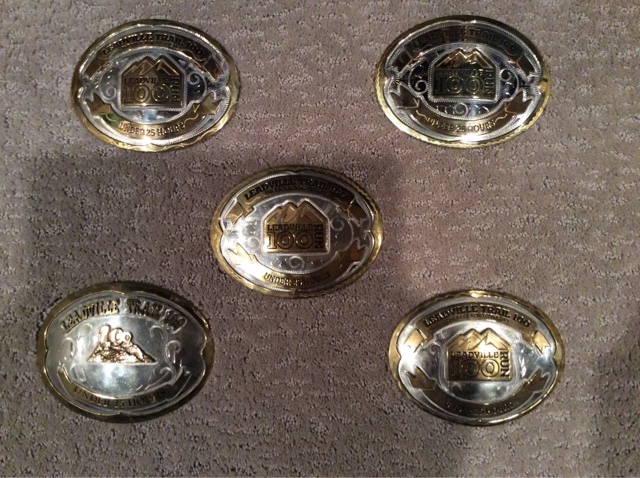
Despite the meteoric growth of the Leadville Race Series, especially in past decade, the 100-mile run still represents what Chlouber and Maupin have called "the heart and soul" of the race series. Its motto, “You are better than you think you are and can do more than you think you can,” has long-defined the challenge. Just about anyone who's experienced and finished Leadville knows those words aren't a platitude; they mean something. You have to believe deep down you will finish. Just as with the hard rock miners of years past, if you dig deep enough, you will find silver and gold—in the form of the race’s famously huge finisher's belt buckle. But you'll find far more. Leadville takes you close to the razor’s edge of your limits and then deep into your own soul.

My 2010 buckle. Note the quarter, which is there for scale.
Even when we lived in Ohio until 2010, reading and re-reading enthralling accounts of the course and race, told by legendary mountain runners and Leadville winners like Anton Krupicka, Timothy Parr and Carpenter, I couldn’t help but fall in love with the race and town, dreaming of one day lining up for this legendary challenge. I reasoned that Leadville might be a stretch for a flatlander like me, but I still dreamt of it. (Side note: It is rumored that Krupicka, the night before winning the 2006 Leadville 100, slept in a local public restroom. Not sure if that's true but, if it is, it's hilarious.)

In 2010, my dream became a reality when Anne and I took advantage of the opportunity to relocate to a town southeast of Denver, Colorado, where we lived at 6,150 feet of elevation—more than a mile in a sky. When we arrived in Colorado, it was early spring and I still had time to register and train for the Leadville 100.

Amid my dreams of running this historic race was hesitation. I was scared, not of the distance but of the mountains and the elevation. Day after day I pulled up the registration page on my computer, never quite finding the courage to register. But then one day I got the nerve to sign up. Just like that, I was in. I had four months to get ready.

How did it turn out? Click here.

Sunday, December 10, 2017

Thoughts on Harmony and 2018

A few weeks ago, I was reminded of a blog post, written by ultrarunner Mark Carroll after the 2009 Mohican 100-Mile Run:

"At this point in the race Wyatt Hornsby must have been running a bit scared. Wyatt had just done something that he must have envisioned on a hundred training runs over the past year. It was bold and it was ballsy and it was unlikely. He had run well back from the frontrunners all day long; keeping them just within range. This was a wise strategy. But just a while ago his patience, alertness, and knowledge of the course allowed him to take over the lead from Mark Tanaka of San Francisco and he was now irrevocably committed to pulling off his goal of winning the Mohican Trail 100 Mile Run. This was the work of a believer. Wyatt was a good runner. In fact he had finished in the top five in a local 50K race on this very course a few months ago. But this was Tanaka’s race and everyone knew it. Well, almost everyone. Tanaka was the genuine deal. He was a member of the famous La Sportiva Mountain Running Team. Wyatt was running ruthlessly. He refused to walk on even some of the steepest climbs and increased his effort time and again over the final miles. Think of Rocky climbing off the canvas for a knockout. Wyatt crossed the line to the delight of all skinny-low-heart-rated Ohioans, in first place in 19:52."

Needless to say, that got me fired up (my report from that race here). It reminded me of a time when I felt I could almost float over the trail. I ran fearlessly in races because I knew I was in such great shape. I knew that I could push myself super hard and still have gas in the tank for a strong finish. A lot has changed since then, and I'm not just talking about age. I realize that I have gotten away from certain training practices that really helped me then and that could help me now. I am working to re-integrate those practices. No need to talk about them here; the important thing is that I am doing them.

***

With 2017 coming to an end, I am starting to think about my race schedule for 2018. It has been a challenging year on a few fronts and I am excited about 2018.  I recently heard a guest on the Rich Roll Podcast (excellent podcast show, by the way) equate the endurance athlete's life to a three-legged stool. One leg is their professional life/job. Another leg is their family. The third leg is their training. If one of those legs is compromised in any way, the stool comes apart and the athlete falters. One's life needs to be in balance--in harmony--for optimal performance on the road and trail. I am looking for harmony in 2018, and I feel that my heart is in a really good place right now, which is a good sign.

With that said, I managed to finish 2017 with a decent performance at the local Turkey Trot 5K. Despite very little speedwork going into the race, I pulled off an 18:48, good for sixth overall in a field of more than 2,200 runners and walkers. The five runners who finished in front of me were all high schoolers, so not bad. But let me tell you: 5Ks hurt! I am confident that, with proper training, I might have a shot at once again going sub-18 for 5K. I've started getting back to the track every single week, recognizing that it'll pay off in a big way in races of all distances in 2018. When it comes to speed, "use it or lose it." I am committed, as in ironclad committed, to running hard at the track weekly from here on out.

Also for 2017, I am on pace to finish the year with a little more than 3,000 miles. This will be my eleventh consecutive year with 3,000 or more miles. It'll be my lowest-mileage year of the eleven but I'll take it as I suffered through a really nasty knee injury in the early spring that had me wondering if I would be running and racing at all in 2017 (it's ultimately what took me out at Leadville this year). That little knee tweak aside, I am so grateful for the durability my body gives me every year.

***

Lottery gods permitting, 2018 will feature a return to the Leadville Trail 100-Mile Run. If that's the case, I'll be lining up for my sixth finish. I am still chasing the 1,000-mile buckle at Leadville. At this point, it seems so far away. If the 1,000-mile buckle were parallel with the race course itself, I have just gotten to Winfield (the halfway point) and am turning around for the arduous trip back up and over Hope Pass. I am very inspired to get after it at Leadville in 2018.

If I get into Leadville, then I am confident the rest of the 2018 schedule will shape up nicely. I am looking at a potential outing in April to the Grand Canyon, where some buddies and I will run rim-to-rim-to-rim. I have always wanted to run the Canyon and am excited.

So 2018 could be looking like the Grand Canyon in April and Leadville in August. Add to that a potential Colfax Marathon in May and the Leadville Trail Marathon in June and that looks like a pretty good spring and summer schedule to me.

If I don't get into Leadville, I'll likely register for the Never Summer 100K, a grueling mountain race here in Colorado, followed by either Run Rabbit Run up in Steamboat Springs or Javelina Jundred in the hot Arizona desert. I am kind of leaning toward Steamboat.

Would love to hear what your race schedule in 2018 is looking like. Chime in if you'd like.

Monday, June 19, 2017

Who's Going to Win Western States?

The "Big Dance" is only five days away and the pre-race hype has hit a fever pitch! It could be a "fire and ice" year at the Western States 100-Mile Endurance Run. As has been reported, there's still a lot of snow up in the high country and, as of last night, the forecast for Auburn on Saturday is a balmy 98 degrees. Fire and ice! When I ran WSER last year, there was basically no snow up in the high country and we were able to cross the American River by our own power. Probably not the case this year!

I mostly agree with AJW's picks for the guys and gals, which is to say I like Jim Walmsley as the top male and Kaci Lickteig as the top female. Those two seem to be the consensus picks. As Meghan Hicks from iRunFar correctly pointed out, the only person who can beat Jim Walmsley is...Jim Walmsley. I think, on Saturday, Walmsley takes the lead and never relinquishes it, running at the front the whole time but certainly feeling the pressure from a stacked field behind him. He finishes/wins with a time of about 14:55.

On the women's side, I just think Lickteig operates on another level (similar to Walmsley), though certainly Magdalena Boulet (former Olympian and 2015 Western States champ) and Stephanie Howe (2014 champ) are no slouches and will be ready to pounce if Lickteig falters (which I doubt will happen). Lickteig weighs maybe 100 pounds soaking wet but, like Ann Trason, is a full-on badass.

So there you have it: Walmsley and Lickteig both win. But I am going to say that neither sets the course record for their respective genders.
  
***
  
For whatever it's worth, my training is progressing nicely. My right knee is better than 90% (knock on wood) and my left knee is about 80%. My left knee starting barking at me likely because it was compensating for the right knee. But both are on the mend and, fortunately, there's always KT Tape if I need a little extra support. But, overall, the body is holding up very nicely and I'm liking where things are with the Leadville Trail 100-Mile Run now about two months away. I'm getting in some good training and have prioritized legit trails on days that I can get to the foothills and/or mountains.

That said, it is clear to me that, with age, I'm slowing down, especially on the trail. But yet I have never felt stronger. While I have clearly lost a step, the raw endurance is there more than ever. I can go a looooooooooooong way. It would be interesting to run another 24-hour race and see if I could go north of 135 miles. I feel the maturity is there to crank out 135+ over 24 hours. Maybe next year?

Finishing the Leadville Trail Marathon
on Saturday.
Last month, I lined up for the Colfax Marathon, a road race in and around downtown Denver, with a back-of-mind goal of qualifying for the 2018 Boston Marathon. Though I did snag that BQ time, it was by no means easy! With a fair number of hills and the "mile high effect" in full force for all 26.2 miles, this race is no joke. At mile 10, I was feeling it but somehow hung on and came in with a just-okay time of 3:13, good for a BQ but probably just short of the threshold for being able to gain entry into the actual race due to what will surely be high demand. We'll see how it goes. If I don't get into Boston, I will not shed a tear for I'll have a winter of skiing in the Rocky Mountains to look forward to. But it would be nice to go back one of these days.

Then this past weekend I lined up for my sixth Leadville Trail Marathon. This year, due to very heavy late spring snow in the high country, we ran the snow route, which misses Ball Mountain but still takes you up Mosquito Pass, which tops out at 13,185 feet. Given that I had put a decent effort into the Colfax Marathon, my goal for the Leadville Trail Marathon was simply a strong training run up high. And that's what I got from it. Despite absolutely brutal 50+ mile per hour headwinds at the top of Mosquito Pass and some stomach discomfort around mile 22 (nothing ever came of it--just some discomfort), I crossed the finish line feeling good. The snow course throws at you a mind-blowing 12,600 feet of combined elevation change, all between 10,200 feet and 13,185 feet, over the 26.2 miles. I must have run it at a smart, conservative pace because I felt great the next day and feel good again today. No post-race issues at all.
  
My next event is the Chase the Moon 12-Hour on July 7. Again, the goal is a strong training run. I had originally signed up for CTM with a goal of 50 miles but we'll see how that goes. If I can get in 40 strong miles and walk away feeling good, that's OK, too. But 50 miles would be optimal.

***
  
Best of luck to all toeing the line at Squaw Valley Ski Resort this weekend. If you have made it this far, you have guts and determination to the max. If you cross that finish line, you will cross it as a champion and will never look at life the same. It's the most magical ultrarunning experience I've ever had.

Now it's your turn: Who ya got for Western States--top male, top female and the podiums for each?

Sunday, April 30, 2017

The Mountains Are Calling; Thoughts on Anton Krupicka

It has been an up and down spring. Through mid-March, my training was going super well. I had put in a few 20-milers and had started to get to the Foothills trails (which at the time were crazy dry) for some long runs. Speedwork and tempo runs were coming along, too. But then on a 20-mile run up through Waterton Canyon and into Roxborough State Park on Sunday, March 19, it all came apart...my knee, that is. Oddly enough, my knee only hurt a little on the back half of the run but then the next day I was barely able to walk.

Having experienced this injury before (back in 2008), I know exactly what is it: patella femoral pain syndrome, also known as "runner's knee." Although painful and aggravating, it's not a serious injury as it involves no structural damage. It mostly just requires time and patience. And that is what I'm giving it...time, patience and lots of KT Tape, foam rolling and ibuprofen! My knee gives me good days (like yesterday and today) and not so good days (like on my run on Friday in Topeka, Kansas).

The most aggravating aspect of the injury is that it interrupted what was shaping up into a really strong spring buildup...with a Boston bid at the Colfax Marathon in sight. Not sure that's going to happen as I have done no speedwork, no tempos and no 20 milers in the last 6 weeks...meaning my fitness has taken a hit. So, as of now, Colfax is a question-mark.

My main focus is getting my knee back to 100% so I can line up with a reasonable amount of confidence at the Leadville 100 in August. As of now, it is not ready for big descents in the mountains. Far from it. But the good news is that it's getting better and over the past two weeks I have gotten in 126 miles, which isn't great but it's progress toward what I'm hoping will be weeks of 80-90 miles going into my taper. So we'll see how things shape up. I am really hoping my plans for the Leadville Trail Marathon and Chase the Moon 12-Hour, as well as some Fridays I'll be going up high, hold up because they're there to get me ready for the 100 in mid-August. To say the mountains are calling would be an understatement. I am so ready to get up high and do some epic stuff this summer.

***

Life has been so busy. Last week, I spent four days on the road (two in Albuquerque, NM and two in Topeka, KS), leaving me feeling pretty tired (read: exhausted) going into the weekend. The good news is that there is no travel in the immediate future but right now I'm feeling like my life is so dominated by everything not called running. Running is like this little thing in the back of my mind and I have to remind myself that I have this big race in August called the Leadville Trail 100-Mile. I was starting to get into it when my knee blew up but, over the past 6 weeks, I've felt distracted, a bit stressed about the injury and overall insecure. Take away my physical prowess as a runner (leaving me with a bum knee) and I'm left a bit exposed and vulnerable. It's that way with every runner I know--we're an injury away from being a basket case. I have not been a basket case, but I'm not at my best when I have a bad wheel.

Which means I'd better have a good backup plan when I "retire" from this sport due to old age, if ever. It might be then that I take up being a race director, a career aid station volunteer...or something like that. I can't imagine a life not involving ultras. A few weeks ago, I watched the new documentary about Karl Meltzer's record-setting run on the Appalachian Trail and I have to say I was struck by Dave Horton's efforts to keep the Speedgoat going. As I watched the movie, I thought to myself, "Someday I can see myself doing that...being the older, grizzled veteran out there helping the younger guys get it done." Except I'm no Dave Horton. There is only one Dave Horton.

***

There's an article on Trail Flow about ultrarunning in the "post-Krupicka climate" that's got a lot of people talking. The reason is that it's a rather strange article in its nauseating fawning over Anton Krupicka. The author basically says Anton represented the end of an era for mountain trail running and that the sport is now impure, soulless and dominated by fast guys, like Sage Canaday, who aren't "true" mountain runners like Anton was. The author doesn't even know Sage and yet kind of attacks him, saying he has a "stupid haircut" and would rather run intervals than up mountains. Hmmmmmm. As I read the article, it occurred to me that the author is new to the sport (he admits his inspiration came from "Born to Run") and doesn't really know much about its history, let alone the fact that Sage is one of the nicest guys in all of ultra (saw it firsthand at Run Rabbit Run last year).

What I think about Anton doesn't really matter but I have always felt some people don't fully understand the kind of runner he actually was/is. When you look at Anton's best races, most of them were on runnable courses...like Leadville, Miwok, White River, Western States (where he finished a very strong second), Rocky Raccoon, etc. He is indeed great in the mountains--one of the best--and I really hope he finally gets a crack at Hardrock, but Anton is first and foremost an awesome runner. I would not put him in the category of Kilian Jornet, the most dominant mountain runner on planet Earth. Anton in his prime was a great runner who performed brilliantly on very challenging but mostly runnable courses, some of which involved mountainous peaks. But every day he tagged Green Mountain or did some epic run in the Rocky Mountains--all of which he recorded on his well-trafficked, amazing blog (which has since been replaced with a fancier website)--and over time this became how people viewed him...as a mountain running god and living legend. It brought him mythical status and a cult-like following, as exemplified in that aforementioned trashy Trail Flow blog that made many people queasy.

Anton inspired many people, myself included. His prime coincided with a magical era for the sport, and this era was beautifully captured in his blog (Anton's old blog was in a league of its own). I remember in 2010 going up Hope Pass during the Leadville 100 and seeing him come barreling down the mountain in the lead and near course-record pace (alas, he would later crash and burn going up Powerline). It was quite a sight.

I think for working guys, the thought of living in your truck all summer, bathing in mountain rivers and basically bagging peaks all day and everyday--as Anton does/did--has some major appeal, because all of that seems so much better than being a working stiff with a lawn to mow. What this appeal comes down to can be summed up in one word: Freedom. We humans yearn to be free and Anton embodies freedom. He lives by his own rules and basically is a professional runner and peak bagger. This really resonates with guys.

And so a lot of people live(d) vicariously through Anton. Yeah, while Anton is still around, mostly doing non-running stuff like biking, climbing and backcountry skiing--and hopefully plotting a comeback to ultras--the sport is definitely missing him. But life goes on. Just because he isn't racing right now (I think he is young enough to come back very strong and win again, if he can stay healthy) doesn't mean the sport is impure, as the author of that crappy blog suggests.

With that, a final point: In almost all facets of life, there will always be tension between old school and new school. The only constant in life is change. The young and fast guys in ultra--guys like Jim Walmsley--represent a new breed of runner. Doesn't mean they're better (or worse) than the guys before them. It just means they're a different breed of runner in a sport that's always evolving. I am excited to see what these young and fast guys do (so long as they do it the right way), just as the older guys probably said about dudes like Scott Jurek back in the 90s. I for one will be pulling for Sage at Western States this year as I think Sage has struggled in 100s and is due for a big one (he's not quite as young as Walmsley but he's still a kid in my eyes).

I don't ever want to be that guy who trashes and immediately discounts the new it because it's not what it was like "back in the day." Like Dave Horton, I want to be around the sport for years to come, surrounding myself with people of all ages and celebrating what makes ultramarathoning so unique and special: a community of like-minded folks out there putting one foot in front of the other in nature.

Saturday, March 11, 2017

How I'm Going to Be Ready for Leadville

My race schedule for 2017 is firming up quite nicely. Going into 2017, I kind of wanted to run a road marathon and go for a Boston Marathon qualifier time but I didn't know how that might fit into the mix, or if I was willing to put in that kind of training. But over the past few weeks, I have been doing some quality workouts, like track intervals and tempo runs, and I plan to keep it up as it seems to be improving my turnover. I've also gotten in a few 20-milers and plan on another one tomorrow. My weekly mileage is between 60-65 right now...a nice early season base. As this process has unfolded, the road marathon has entered my mind. I do want to go back to Boston.

Top-end speed has always been an asset of mine as a long-distance runner. I can think back to several races where I was in a sprint finish against another surging runner and managed to cross first (my banner photo captures one of those moments). And yet, over the past few years, I have definitely felt it slipping due to aging. And not just top-end speed. I am losing speed all the way around. Use it or lose it. So I am working hard right now to get some speed back.

I still have a long way to go before I consider myself ready for a Boston qualifier effort on the road but things are coming together and I am eyeing the Colfax Marathon on May 21. I would be thrilled to cross the finish line in under 3 hours and 5 minutes.


People say to me often, "a marathon must be easy for you!" My response has always been that if all I had to do was run 26.2 miles at a slow pace, then, yes, it wouldn't be that hard for me or nearly any ultrarunner. But to "race" that distance in pursuit of a goal time...super hard. When you are racing 26.2 miles on the road, every second counts. It hurts and the pressure is on. I kind of like that!

When I was on a nice run in 2008-2009, breaking 3 hours in three consecutive marathons, the effort I put into those races was significant but, being in my mid-30s at the time, I recovered pretty quickly and moved on to the next thing. When I look at 2009, for example, I am shocked by what I was able to do within my own abilities. Now that I'm 43 years-old, I am well-aware that, after a potential BQ attempt at Colfax this spring, I will need some recovery. That's what First Endurance Ultragen is for! But the recovery window will need to be limited because Leadville is on the horizon.......

From Colfax (haven't yet pulled the trigger on it, but it's likely), it's going to be the Leadville Trail Marathon on June 17, the Chase the Moon 12-Hour on July 7-8, and then the big one...the Leadville Trail 100-Mile. I will use the Leadville Trail Marathon as a long training run up high. It will not be a race effort. Same with Chase the Moon, where the goal will be 50 "easy" miles in 12 hours, which I feel is quite doable. I had considered making the Silver Rush 50-Mile Run up in Leadville my 50-mile training effort going into the 100-miler but I feel that Silver Rush might put me in a recovery hole given that it's 50 miles above 10,000 feet in the mountains. Chase the Moon, which is hilly but not mountainous, seems a bit "smarter." When I look back on my running "career," all of my best 100s were preceded by 50-mile runs. So I feel strongly that I need a 50-mile effort and Chase the Moon fit the bill perfectly. Doesn't hurt that it'll be logistically easy to pull off, given that it's just up the highway from me.

Throughout the summer I will be making a point to get up high and train above 10,000 feet and ideally knock off some 14'ers. The name of the game is steep and high. On the list as of now are:
  • Grays and Torrey's Peaks - did these in 2013 and want to go back, but this time I will start from the lower parking lot right off I-70.
  • Hope Pass double crossing - required!
  • Longs Peak - will be logistically challenging to pull off but it's on the list. Backup would be Pikes Peak.
  • 20-30 mile effort on the Colorado Trail starting at Kenosha Pass.
  • A few new sections of the Colorado Trail, such as the section from Copper Mountain up to Camp Hale.
I feel that if I can get in several efforts above 10,000 feet, where the terrain is steep and nasty, I will be ready for a good crack at sub-24 at Leadville. I have two efforts of 22 hours and change at Leadville and would love to make a run at that kind of time but for 2017 I am gunning for sub-24. I know my stomach will go south, so it's really a question of how I minimize the impact. And I think that more training on steep terrain up high, all within weeks of 80-90 miles, will hopefully better condition my stomach for what will come on race day.

Monday, January 16, 2017

Going Back to Leadville, the "Race Across the Sky"

Yesterday I got the absolutely awesome news that I've once again been selected in the Leadville Trail 100-Mile Run lottery. I was super nervous! Many Western States 100-Mile Endurance Run qualifiers have sold out, which meant my list of backups (were I not selected for Leadville) was shrinking.


Even with five finishes going into the Leadville lottery, I just didn't know what my odds were. Were my odds the same as someone with no finishes, or did I have extra tickets or some other consideration that increased my chances? I just didn't know. Lifetime Fitness has the right to run the lottery how they see fit (so long as it's fair, which I'm sure it is), so I am not here to tell them what they should and should not do. But this I will say: Good on them for having a public event where the results were announced.

Actually, I do have one suggestion. Given that so many races quickly sell out these days, I might recommend that Lifetime move the lottery up a month, so it happens maybe right after the Western States drawing.

At any rate, I am so glad I'm in. The work to prepare begins now! I have my eyes on the 1,000-mile buckle, which hopefully will come in 2021. I am committed to it. But that'll be a topic for future posts.....

When I look at my Leadville finishes, I am well aware that my results are getting worse. I am sure aging is a factor, but so is my stomach. While, at this point, there is nothing I can do to stop the aging process or make my sensitive stomach ironclad, I am sure I can improve on things a bit. For starters:
  • I am going to increase how much time I train at elevations of 10,000 feet and more. This will require some short-term sacrifices, for sure, but it should help get me better-prepared for the Leadville elevations..... 
  • I am going to put a greater emphasis on vertical gain so as to reduce the stress on my body (and stomach) of the big ups and downs that Leadville brings. This will mean a somewhat smaller emphasis on pure volume.
  • On big outings to the mountains, I will practice raceday nutrition. This one is a no-brainer.
  • I'm going to have fun. There are some runs that I'm eager to finally do this summer....
I am not so naive to think all of the above, plus a few other things like using Ultragen for recovery and Optygen to boost performance, will result in a race without stomach issues. I will have stomach issues; the key is to minimize their impact as much as possible. But if I do what's listed above, it will help, especially on the Hope Pass section, which has cost me a ton of time in recent years.

So the 2017 schedule is now shaping up nicely. I am in the Leadville 100 (August 19) and also the Leadville Trail Marathon (June 17). I am looking to add in a spring road marathon (maybe Colfax on May 23) and potentially a summer 50-miler, such as Silver Rush. Silver Rush is about 6 weeks prior to the 100, so really good timing.

Congrats to all who got in! It's going to be an awesome 2017!

Thursday, December 22, 2016

A Leadville summer

With 2017 just around the corner, I may be one of the only runners without a definitive race schedule for next year. The reason I don't have a schedule (yet) is that I am waiting anxiously to hear the results of the Leadville Trail 100-Mile Run lottery. The lottery results will be shared in mid-January.

For some reason, I have never been more nervous about my chances of getting drawn in the Leadville lottery! I simply don't know if I'm getting in, even with five big buckle finishes. Given that I have made the commitment to earning the 1,000-mile buckle (I am halfway there!), my hope--my wish--is that my name will be pulled from the hat and that I'll be among the lucky folks lining up at 6th and Harrison at 4am next August 19 for 100 miles of fun. Because--well--there is no place I'd rather be in that moment in time. No place.

Not to go on a tangent, but Leadville is such a unique experience. I have never run a race like it. The energy, the holy-sh%t factor...just epic. That's why I keep coming back. Leadville has become not just what I do every August; it's become who I am. When I am not in business attire, you can find me wearing one of my Leadville shirts and always my black Leadville hat. It's my identity. 


So, if all goes to plan, I will get into the 2017 race and earn that 1,000-mile buckle in 2121, when my son is 13 years-old and able to pace me from Mayqueen to the finish. And when we cross the line together, my hope is that the gift of this race will pass from me to him (unless I decide to gun for the 2,000-mile buckle!). It'll be his if he wants it.

If I get into Leadville, the schedule for 2017 will quickly fall into place:
  • Spring marathon TBD 
  • Leadville Trail Marathon - June 17
  • Leadville Silver Rush 50 Run - July 9
  • Leadville Trail 100-Mile Run - August 19
Yeah, a Leadville summer it'll be. And if I don't get drawn in the Leadville lotto, it'll be decision time. I would have two options to consider.

The first would be to sign up for another 100 in the summer and then build out a race schedule that prepares me for whatever 100 that may be...a return to Mohican? Revenge on Bighorn (if Bighorn is even open then)? Run Rabbit Run? Who knows? The second would be to go to Austin in April and try to grab a slot for the Leadville 100 at the Rattler. This option would be far from ideal and, honestly, I would probably not do it because I don't want that many unknowns surrounding a sport that is supposed to bring me happiness. So, if I don't get into Leadville, I'll likely be looking for another 100 in 2017.

So, here's to hoping I get into "the Race Across the Sky," lottery gods willing!

Monday, October 3, 2016

2017 Thoughts

Like a few other runners I know, I have yet to reach the place where my race plan for 2017 is crystal clear. And that's OK because we still have three months left in 2016 and I'm going to enjoy them!

I am still processing (and recovering from) my Western States/Leadville double summer and am now cramming for the Rock 'n' Roll Denver 1/2 Marathon in a few weeks. Obviously the endurance for a half-marathon is more than there. Right now, the emphasis is on building some speed so I can get it done in a decent time. Then it's ski season!

As with past years, as I look at the upcoming year, no one race has really jumped out and grabbed my attention. At this point, my thoughts are mostly focused on some specific goals I'm considering, including:
  • Running a Boston qualifier. Not sure I have another sub-3 marathon in me but I sure would love to give it a solid go in the spring. Although I have settled on no specific race, I am mindful of the fact that the Colfax Marathon is local and may be a good option.
  • Re-qualifying for Western States. After a 26-hour slog that left a bad taste in my mouth, I feel a desire to return to Squaw Valley Ski Resort in the next few years to break 24 hours. Not sure what Western States qualifier I may run in 2017 to stay in the lottery but it's a goal.
That's about it. I am also tossing around the idea of hiking the first 110 or so miles of the Colorado Trail over 3-4 days, likely in July. I love the idea of starting in Waterton Canyon and finishing at Copper Mountain Ski Resort and then over the next 3-5 years covering every inch of that epic trail. If I do the the Waterton to Copper Mountain stretch next July, I will want some company and, of course, I will need some very nice gear that doesn't weigh much at all.

I saw that the Leadville Race Series has released the date of the 2017 Leadville 100 run. I just can't seem to pull the trigger on committing to Leadville in 2017. Honestly, I think it's doubtful. I have five buckles and have decided that, if I line up for Leadville again, it'll be with the goal of getting that coveted 1,000-mile buckle. I'm just not ready to make that kind of commitment, so as of now Leadville in 2017 is fairly doubtful. That could change......

Looking back on my training for the Western States/Leadville double, I can definitely see where I fell short (what can I say? I am always analyzing). While pure running fitness/endurance and a positive attitude were there, what I really lacked was specific attention to big vertical. Simply put, I am putting in the miles but I need to spend more time on steep mountains going up and down. Hills aren't enough. We have a mountain not far from us (45 minutes)--Mount Morrison--that would have been perfect training for Western States as it's steep. When you have not done enough vertical in training, the vertical you encounter in a race will put a lot of stress on your body (and mind). That kind of stress can do a number on the stomach.

Looking back on Western States, I was so ill-prepared for those steep canyon descents and climbs in the middle portion of the race. The steepness of the descent into Deadwood Canyon was simply mind-blowing; it was almost like stepping off a cliff. The climb out of the canyon and into Devil's Thumb was no walk in the park, either. While I was in great shape to run 100 miles in the heat, I simply wasn't ready for that undulating course, and so it's no surprise that by Foresthill, where a puke fest ensued, the race had nearly broken me. I am amazed that I finished.

I'm not saying my stomach issues all go back to a lack of vertical in training; what I'm saying is that I feel I could improve my situation a bit if I did more steep vertical in training. It then becomes an issue of willingness.... Am I willing to devote the time to doing such vertical when I have other priorities in life?

During the Run Rabbit Run 100-miler a few weeks ago, I had a conversation with a very notable elite ultrarunner who has also battled raceday stomach issues over the past few years. When I told him that my stomach seems to give out on me after 50 miles, he replied, "You know what the answer is, right? Don't race more than 50 miles." That's what he's taken to doing, but I'm just not quite there yet.

This is always the time of year when I love to hear what others are thinking about in upcoming year. So do please chime in with your possible plans!

Tuesday, August 30, 2016

Grit, Guts and Determination: 2016 Leadville 100 Race Report

The frustrating thing about 100-mile races of late is that my legs are capable of so much more than my stomach will give over the distance. Almost anyone who saw me run the Leadville Trail 100-Mile Run, which took place Aug. 20-21, would tell you my legs are good for 21-22 hours on that course but my stomach just won't have it. And so it was with this year's "Race Across the Sky."

First and foremost, I want to express heartfelt gratitude to my family and friends who were on hand to support me. This included my wife and our son, my father-in-law, AJ Wellman and Chuck Radford as my pacers, my boss and her husband, esteemed co-workers, and many others. Even if you weren't able to physically be there, you were in my thoughts--especially if you're family. Everyone's support meant so much to me and I am deeply grateful for it. Thank you.

When I came into Twin Lakes outbound (mile 39.5) in one of my best-ever splits for that aid station (6 hours, 46 minutes), I felt so good. I had run the first 13 miles with my buddy, Mark, in a conservative 2 hours, 4 minutes (we had great conversation the whole way, which made a huge difference) and then really opened it up from Outward Bound to Twin Lakes. As I descended into Twin Lakes, enjoying those spectacular views, I remember thinking that I'd had a good taper and my recovery post-Western States had been much better than expected (thank you, Ultragen!)--bringing me to this almost euphoric point. Nearly 40 miles into the race, things were looking up.

Coming into Twin Lakes, mile 39.5
Upon arriving at TL at 10:46am, I looked at my family and crew and said something along the lines of, "it's too early to tell but this could be a magical day." My UCAN, Larabars, Fuel 100 Bites and water infused with peppermint oil seemed to be working. My wife was shocked by how good I looked. Off I went toward the meadow en route to Hope Pass, ready to get after that big climb, taking you up to 12,600 feet.

Alas, I felt quite labored on the climb up the frontside of Hope, ultimately coming to the realization that my climbing legs were compromised...maybe from Western States itself but likely from limited trail running in the past several weeks as I recovered from my adventure from Squaw Valley Ski Resort to Auburn. But I didn't let it get to me too much because, even with sub-optimal climbing legs, I knew I was in good pure running shape. 

I got into the Hopeless aid station (mile 45) two hours later. There, I took stock of the llamas (they always catch my eye) and recharged with some delicious potato soup before heading off for the crest of the pass. The section from Hopeless to the crest is always such a grinder for me, especially those last few steps before you hit the top, which affords the most spectacular views you could imagine. 

I was a few hundred vertical feet below the top when Max King, followed by eventual winner Ian Sharmin, came blowing past me (obviously in the opposite direction as this is an out and back course). Watching Max, I immediately thought back to the 2010 Leadville in which Anton Krupicka was at about this point when I saw him...only to blow up (and DNF) on Powerline (I have always been a big Anton fan). Turns out Max would also blow on Powerline, but credit to him for his gutsy finish a la Matt Carpenter in 2004 (as we know, Carpenter returned the next year, setting a legendary course record that still stands). 

The descent down the backside of Hope Pass was slow and goofy. I am not a good descender of steep trails. I got into Winfield (mile 50) in 10 hours and 4 minutes, on pace for a time of about 22 hours. This was about 10 minutes behind pace.

Entering Winfield, I was a bit upset with my poor descent and compromised climbing legs but the stomach was still solid and that was a huge plus. I made a point to stop at the creek before the aid station and dip my hat and Buff scarf in the cold water. Entering Winfield from the Sheep Gulch Trail, it was much, much hotter than the forecasted 65 degrees! When you're at 10,000 feet and the sun is out in full force, 75 degrees is quite warm. I needed to cool off and the stream provided some needed relief.

At Winfield, I picked up my friend and pacer, Chuck Radford, who placed fourth at Leadville last year. We decided to take my trekking poles as they'd help me on the climb up the backside of Hope. Chuck and I walked out of the aid station and up the little spur and then began running on the mostly downhill Sheep Gulch Trail, which goes on for about 2 miles until you come to the based of the Hope Pass climb. I tried to get in some calories in advance of the big climb up Hope but then it hit me...sudden nausea. I leaned over and vomited and then dry heaved. Not an ideal situation before a horrendously difficult 2,600-vertical-foot climb with grades of 30% in some spots, but in a situation like this one--which I've experienced more times than I care to admit--all you can do is get it out of your system and keep going. 

Even such, I was worried, confiding to Chuck that I didn't know if I'd make it up the mountain with my legs feeling so unresponsive on the climbs and now my stomach turning on me. Chuck was a steady hand, encouraging me to take it step by step. "We'll get this done," he said. And, deep down, I knew I would. Onward!

The climb up the backside of Hope wasn't pretty and it involved a few more puke breaks, including one very bad episode above treeline. But, step by step, we got to the top and then started slowly making our way down. By then, I was completely depleted and we were very low on water. Poor Chuck had to give me almost all of his water. I told Chuck that the plan for Hopeless inbound (mile 55) would be to recharge with some of that delicious potato soup and come into Twin Lakes ready for the final 40 miles. 

This is where I became my own worst enemy.

It was good that when I got into Hopeless I sat down and started going to work on the soup. It was not good that I ate the soup--all two cups--entirely too fast when my gut had shut down sometime right leaving Winfield. Sitting in the tent, I practically inhaled it and then--wouldn't you know it?--vomited it right back up as we departed the station. So, leaving Hopeless inbound, there I was again...depleted.

Fortunately, Chuck had the good sense to leave Hopeless with a bottle of Roctane that I nursed during the long descent back down to Twin Lakes. I told Chuck that I felt my gut might just restart at Twin Lakes, which is "only" 9,200 feet, and that between here and there I just had to grind it out. 

Making matters worse was my left knee. Descending the mountain, I felt pain under my kneecap but it didn't stop me in my tracks. I'd just have to endure it...for 40something more miles. As of this writing, my knee is improving.

In the meadow, with Twin Lakes in sight, with Chuck.

Finally down in the meadow, we forded the stream and various water crossings and mostly ran into Twin Lakes inbound (mile 60), where my crew awaited me. It was here that I also saw my boss and her husband--a nice lift to be welcomed by so many people who care about me and I care about as well. I told the crew what had happened on the mountain with my stomach but I felt determined to keep grinding it out, though--yes--I felt dejected that it had taken me a little over 7 hours to clear the Hope Pass section...yet again. Seven hours. Unbelievable.

Being attended to by Chuck, AJ and the crew at Twin Lakes.

I picked up my friend, AJ Wellman, at Twin Lakes, where I changed shoes and socks (so nice!), and we left at about 5:30pm, with our headlamp as the sun would be setting in a few hours. I had fueled just a bit in the aid station but we left with some calories, including Fig Newtons, Skratch, and a few other items. The climb out of Twin Lakes was tough, especially the lower section on the steep rocky dirt road. AJ and I both agreed that we'd hike this section and then start running once it topped out in about 1,500 vertical feet, when you're greeted with a nice, long section of trail that's buttery smooth and mostly downhill. "That's your kind of trail," AJ said to me.

Finally, when we got to the top, AJ and I started running that buttery trail and we had a good stretch going into Half Pipe (mile 70), then Pipeline (73), and then--to a somewhat lesser extent--Outward Bound (76). AJ told me I needed to average at least 15-minute miles and for most miles I was moving at about 10-11-minute pace. Although I'd gotten down a few Fig Newtons, I was mostly depleted as my stomach had never restarted as we'd hoped it would at Twin Lakes. Basically whatever I put in my stomach just sat there. I'm not sure how I kept going except to say it was raw endurance and fat burning at work!

Leaving Twin Lakes with AJ.
About a mile past Outward Bound, you're greeted by the Powerline climb. Arriving at the base of Powerline, I wasn't quite as optimistic about this gnarly section as I usually am. Powerline has traditionally been a strength of mine--I can get up and over it pretty fast and in good spirits. But this time I didn't feel quite as confident because my climbing legs just weren't there. We nonetheless grinded our way up the climb--about 1,800 vertical feet with some legitimately steep sections. AJ told me it would take about 85 minutes to get to the top, and he was right. I took a few breathers along the way and then finally we got into the "surprise" aid station. Only a few steps before the aid station, Mark had caught up with me. I hadn't seen him since Mayqueen and he was looking so good. He would go on to finish sub-24 hours and third in his age group! As for me...I wasn't looking at good as Mark.

After downing a few cups of Ginger Ale (as did Mark), which one might assume would settle a shaky stomach, I was once again hit with nausea and began vomiting right there at the aid station. Only this time it was mostly dry-heaving since I'd been running on empty for 25 miles. But this time, it wasn't just vomiting and dry-heaving; I was hit with the chills and told AJ I felt hypothermic here at 11,200 feet in the middle of no where. So I did what seemed to be the best thing to do: I took a seat in front of a raging campfire to the side of the aid station. Let me tell you, the folks at that aid station were having fun. One guy got up and started massaging my shoulders while he told me what a badass I was. After about 3 minutes of that, I felt inspired to get out of my seat and get going. I was still shaking a bit but AJ and I both agreed that the best bet was to start running down from the pass and hope to warm up versus hanging out at the top of Powerline in the middle of the night. Staying at Powerline, there in front of the fire, was a destination to no where.

What else to say about the descent down to the Colorado Trail via Hagerman Pass "Road" except that it's dark and technical. But I'd been there a few times before and knew what to expect. You have to watch your step here, but at the same time let gravity do the work. And then when you enter the Colorado Trail, a section that traditionally takes me about a half-hour to clear, the name of the game is staying upright because that section of the course is littered with rocks. We nonetheless got it all done despite a few stumbles.

Coming into Mayqueen. (Mile 86.5) at nearly 1am, I knew I needed some downtown. This was for a few reasons. First, I could barely keep my eyes open. If all I had in front of me were 5 more miles, then I'd have kept trucking along. But we're talking about a half-marathon to go. Second, I had started hallucinating on the Colorado Trail. Yep, just like at Western States coming into Brown's Bar, I started seeing basketballs to the side of the trail. So, when AJ and I got into Mayqueen, we agreed that I'd get in one of the cots and close my eyes for 10 minutes. Which is exactly what I did. I've been doing 100s long enough to have confidence in myself that, yes, I could take a short nap in a warm cot and, yes, I could get up on time and start running again. 

Man, was it cold at Mayqueen! Waking up 10 minutes later, I quickly changed into warm clothes, realizing that the stretch from Mayqueen to the finish can be extremely chilly, especially as you're coming off the lake and into town. By chilly, I mean the temperature can drop to the mid-20s. If you are ill-equipped for these cold temperatures, they will take you out of the game. I'm not even kidding.

Rejoining with Chuck at Mayqueen (the plan was for AJ to pick us up at the finish), we power-hiked most of the final 13.5 miles, with some stretches of decent running. By this time, my knee was jacked and I was totally running on empty. I did manage to get down a few more Fig Newtons but by this time the damage had been done. I didn't need a few hundred calories; I needed thousands of calories. I so desperately wanted to be hungry and indulge at Mayqueen but even then my stomach was still shut down. So the trek from Mayqueen to the finish was a grind fest.

I ended up finishing in 24 hours and 25 minutes, earning my fifth big buckle. Where does that rank among my finishes at Leadville?

  • 2010: 24:47
  • 2011: 22:35
  • 2012: DNF (knee)
  • 2013: 22:40
  • 2014: 24:09
  • 2016: 24:25
So, yeah, I'm getting older. Had I run a bit more in those final 13.5 miles, I feel confident I could have broken 24 hours, which would have been nice. But at Leadville they give you that bonus hour for the big buckle, so it was hard to convince myself to go sub-24 when sub-25 was all I needed.


As I reflect on this latest Leadville finish, I realize that I'm experiencing decreasing dissatisfaction with my 100-mile finishes. Am I super proud that I got another big buckle at the "Race Across the Sky"? Oh yeah. But I know I can run the distance so it's no longer a question of, "Am I up for this?" Yes, I'm up for it. The de-motivating aspect is that, again, my stomach keeps undermining everything even as I've tried so many different things in 100s. I know on legs alone I can cover that course much faster. But my stomach won't have it and that's sapping my will to want to keep going back to Leadville.

So will I return to Leadville? I don't know. I have the five big buckles and am battled-tested up there. What else is there to prove? Would I love to have ten? Yes. But that would require a level of commitment that I'm not sure I'm ready to make--not when the wounds from this year's Leadville are still fresh.

Next up: Some shorter, faster races. I just signed up for the Denver Rock 'n' Roll 1/2 Marathon, where I'll be gunning for a fast time.