With the Leadville Trail 100-Mile Run now a little over two weeks away, those of us entered in "The Race Across the Sky" are undoubtedly in our taper or about to begin the taper. Leadville is a fairly unique race in that it's between 9,200 feet and 12,600 feet the whole way. One hundred miles is hard enough; throw in some high altitude and mountain passes and the challenge becomes even tougher.
If this is your first time toeing the line at Leadville and you're unfamiliar with what it's like in the high country and Colorado Rockies, this post is for you (as is my two-part Guide to Finishing Leadville)!
A lot goes into successfully finishing Leadville. You don't want to go out too fast. You need to stay hydrated and fueled. Your stomach needs to stay happy, though you can almost bank on a few queasy moments (or worse). You need to show grit when you're doing the big climbs and thoughts of hopelessness (pun intended) are swimming through your brain. All of that is important, and it's what you'll hear about on Friday afternoon when we all gather for the very motivational pre-race meeting, which I highly recommend.
But there's one thing you may not have thought about, especially if you're coming from sea level. Hell, I even know a few Coloradans who have overlooked or forgotten about this one super-important thing. It's something that can totally end your race.
Are you ready?
Me in the finisher's tent after
crossing the line last year. Note the hat,
sweatshirt and vest. I also had gloves--
and I was still cold.
Stay warm and dry. There's a saying here in Colorado and it goes something like this: "If you don't like the weather in Colorado, give it five minutes."
At Leadville, expect everything from sunny skies and temps in the high 70s during the day to hail, rain/lightening storms of the biblical variety and, yes, snow, especially when you're on Hope Pass. Even if during the day the temperature is in the 70s and the sun is out and life is beautiful, you can expect the mercury to plummet into the 30s after sunset. Cold nights in Leadville are the norm. It's especially cold around Turquoise Lake, which you'll be running along very late in the race (with no other aid stations before the finish). If you aren't in warm clothing after the sun sets and especially along the lake, you will risk hypothermia. And, if you go hypothermic, your race is pretty much over.
So, be sure to have:
Rain gear. Get a waterproof jacket and hat--maybe some waterproof gloves, too.
Warm clothing that will keep you toasty in temperatures as low as 30 degrees. Usually when running in cool temps it's OK to dress on the light side as our bodies heat up with movement. Not so in Leadville after night fall. Dressing on the light side after sunset will get you a DNF.
Emergency poncho. I highly recommend you carry one at all times, especially if we have cloud cover.
One final note: Under no circumstances is littering acceptable on the trail or anywhere on the course. Sometimes stuff falls out of pockets and we don't notice. But it's totally not OK for anyone to intentionally throw trash, such as an empty gel package, on the trail. That is not cool and it will result in a disqualification.
As for me, well, I'm in shape (I think). Those long tempo runs and long trail runs seem to have me ready even as I dropped my peak weekly volume buy 15%. I did a MAF test yesterday morning and averaged 6:30 pace for five miles, with a one-second drop in time when you compare my mile-1 split with my mile-5 split. Not bad. It's my best-ever MAF test result. But MAF tests don't mean much when you're climbing Hope Pass or Powerline. So, we'll see how things shake out. But I do think I have experience on my side and I also think my nutrition plan is solid.
Have a great taper and race. I hope to see you in Leadville!
I can't help but notice from my analytics that a lot of people are coming to this blog for Leadville 100 information.
This time last year I was nervous as could be about the Leadville 100. So nervous that I trained to the point of breakdown and showed up on race morning with a destroyed foot. This year, my outlook is totally different. I've put way more emphasis on trail and mountain running, run more for time than mileage (I'm getting in about 80-95 miles/11-15 hours a week) and incorporated a variety of practices (e.g., running as much on soft surfaces) to keep my 38-year-old body feeling as fresh as possible. Yoga stretches are now part of my training and I've gotten to the point that my ankles and calves are dramatically more flexible than last year. I also have new muscles in my shins! But most important of all, I'm at peace with my training and know what to expect from "The Race Across the Sky."
If there's one bit of advice I could give, it's to stay calm and loose now and through race day.
The next bit of advice I'd give is to start tapering no later than July 31. You can ruin your race by over-training in the 3-4 weeks leading to the big event. Your longest run should be no later than this coming weekend. Late July and certainly August before the race are not the times for super long training runs.
If you're new to Leadville and nervous about what's coming, I've posted a bunch of tips and information here.
After a super-busy stretch at work, I'm just now getting caught up on my blog reading. I came across an interesting comment on Anton Krupicka's excellent blog (see reader comments via this link). Anton has been battling injury and this particular reader cited the following training rules/laws he lives by as an ultrarunner:
It's better to be 20% undertrained than 1% overtrained
When in doubt, leave it out
When you are feeling like Superman, it's time to back off the training and take a rest week
Allow me to offer some observations on these rules. But first I'd like to say I see a lot of merit in these rules.
It's better to be 20% undertrained than 1% overtrained.
I'm going to have to disagree with this rule on the following premise: You don't want to be 20% undertrained or 1% overtrained; you want to be peaking come race time and this comes through strategic build-up, the right level of intensity at various stages in your training, and proper rest, recovery and diet. In other words, keep the needle just below the red! I guess what the reader is saying is that being tired from too much training is going to affect you more in a race than falling about 20% short of optimal fitness. I've never felt 20% undertrained, but I have felt 1% overtrained and I still managed a strong finish. My guess is that I'd prefer the latter. Besides, if you taper right, you can recover a ton over a period of 2-3 weeks before the event and go in fresh and strong. Just make sure your endocrine system isn't stressed--the signs include poor sleep, irritability, diminished sex drive, apathy, depression, etc. It can take several weeks or a few months for the endocrine system to come back.
When in doubt, leave it out.
I agree here. If you wake up in the morning and have an interval session at the track on your schedule but your legs feel like jelly, it's better to skip that workout and maybe go for an easy-pace run or cross-train (note that I didn't say take the day off, but that's an option, too). The track workout can wait until tomorrow. As Ryan Hall has said, let the training come to you--meaning don't force specific mileage or time goals on yourself if you're not feeling it that day. Do what you can. If your legs are toast and you hammer it at the track (been there, done that), you run the risk of injury. Listen to your body and its signals; if your legs are trashed, your body is telling you something. This is a training rule I've only recently fully embraced.
When you are feeling like Superman, it's time to back off the training and take a rest week.
I agree and disagree here. If I'm feeling like Superman, a big part of me will want to play this string out and see where it goes, so long as I--again--keep the needle just below the red. On the other hand, if you're feeling like Superman and push the envelope by running a few extra 1600s or going beyond the 10% rule, thereby going into the red, your risk of injury goes up. It's better, I think, to maintain self-control and know how to handle the good and bad days. But I can't agree that if you feel like Superman you should take a rest week. Great accomplishments almost never come from playing it safe.
Do you have any rules of running? If so, please share!
Amazingly, the Leadville Trail 100-Mile Run has already sold out. The field is now set at 750, and I am sure glad I'll be there on the line. Of the 750 entrants, ~100 won't show because of injury, cold feet and other reasons. Of the ~650 starters, about half will finish. And of the ~325 finishers, about 100 will do so within 25 hours, earning the big buckle. That's my guess based on stats from previous races.
Last year I was a Leadville rookie. Working off a previous blog post, here are some tips for Leadville first-timers based on stuff I learned:
It Ain't Easy. Your Momma Ain't Gonna Hear You Crying for Her from the Top of Hope Pass.
Know what you're getting yourself into. This race is run between elevations of 9,200 feet and 12,600 feet with over 30,000 feet of combined gain and loss. That is hardly child's play. It's clear that Christopher McDougall's best-selling book, "Born to Run," is bringing a lot of people to Leadville every summer. I wanted to run the Leadville 100 prior to reading "Born to Run," but certainly the book raised my interest to an even higher level. When I was coming down Hope Pass during the 2010 run, I saw lots of folks struggling badly up the mountain and clearly in over their head. That may sound elitist but it's true--there were a lot of people at the 2010 race who should have chosen an easier event for their first 100. I saw one guy lay down on a rock totally exhausted and gasping for breath. If you do Leadville, just know that this race is very different than a sea level event.
The Air Up There Ain't Like it is in Kansas
I used to live in Kansas, so I know! There are altitude races, and then there's the Leadville 100. Humans probably weren't meant to run 100 miles at 10,000+ feet. If at all possible, spend some time at altitude before the race, especially if you've never been to the Colorado high country. Also, work on your VO2 max and efficiency. In training for the LT100, I did three runs in Leadville (including the marathon). I summitted Pikes Peak. I did several training runs above 7,000 feet and lived (and still live) at 6,000 feet. I did a number of hard runs--as in 6:50-7:10/mile pace--on a treadmill set at 13% incline. All told, I ran 1,500 miles in 15 weeks. And that wasn't enough to compensate for my inexperience at high altitude. Ideally, if you can do the Leadville 100 Training Camp in June, go for it--it's a golden opportunity to experience the course, learn from LT100 vets (which I'm NOT since I'm just a one-time finisher) and meet other runners.
Here I am at Twin Lakes.
If you're from sea level, show up at least three days and ideally five days in advance of the race and just hang out. This will give your body some time to acclimate. If three to five days isn't possible, show up the day before the race.
Eating at 10,000+ Feet...Sucks
Have a plan for raceday nutrition. I didn't realize that what worked for me at sea level wasn't necessarily going to work at altitude. Going into the 2011 LT100, I'm going to experiment with liquid calories such as Perpetuem, try Vespa and other products (update: My fuel will be Hammer Perpetuem and Hammer gels) and just basically figure out precisely what works for me. There is no one-size-fits-all approach to raceday nutrition. I heard that when he set the LT100 record, Matt Carpenter drank Powerbars dissolved in water. Figure out what works for you, but know that for many eating solids at 10,000+ feet can be brutal, especially late in the race.
Unlike 10Ks and Marathons, Littering isn't Allowed
Littering was a huge problem at the 2010 race. This was very unfortunate and it speaks to the huge number of inexperienced trail runners out there that day. Most ultrarunning vets would never litter. Under no circumstances should any trash be left on the trail. Pick up after yourself. When I won the Mohican Trail 100-Mile Run in 2009, there were multiple times when I stopped--while in the lead--to pick up trash that I'd accidentally dropped. That is the way of the ultrarunner. I think the Leadville organizers should enforce a lifetime ban on anyone caught knowingly littering.
Take a Hike!
In the months before Leadville, work on your hiking, especially uphill hiking. You will hike some of the front side of Hope Pass and basically all of the backside of the pass. You will also hike a big portion of the Powerline/Sugarloaf Pass climb. Training runs are separate from training hikes, but you could incorporate both into your long outings.
My Pole Position
I carried trekking poles over Hope Pass and up the Powerline/Sugarloaf climb during the 2010 LT100. Do I recommend poles for all LT100 runners? For some runners, yes. For other runners, no. I will NOT carry them in the 2011 LT100 but my crew will have them on hand just in case. My concern about trekking poles at the LT100 is as follows--and please bear with me as I explain. Going up Hope Pass, you probably don't want to wear a Camelbak because it's too heavy. You probably want to carry a single water bottle and maybe have a second bottle on a belt. It's hard to handle a water bottle when you also have trekking poles. The same goes for Sugarloaf Pass.
Training Races
I would avoid doing the Leadville Trail Silver Rush 50-Mile Run, which many use as a training run, since it's 6-7 weeks before the 100 and I think that's not enough time to fully recover from 50 miles at altitude. Instead, I would do the Leadville Trail Marathon in early July as a trainer and plan to venture to Leadville plenty in the following weeks for training runs. Basically any race in Leadville is going to be a significant undertaking, so plan some recovery time if you opt for the marathon as a trainer. Disclaimer: The Leadville Marathon and Silver Rush 50-Mile Run are not run on the LT100 course!
Suck on a Straw
If you want a rough idea of what it's like to run at altitudes of 12,000+ feet, get on a treadmill and breathe through a straw or two for several minutes. If you live at sea level and have the resources, consider buying or renting an altitude chamber.
Head for the Hills...or Mountains
Do a lot of hill training. If you live in or near the mountains, there's your training ground.
CREW Means Cranky Runner Endless Waiting
Bring a crew and I would suggest two pacers. The crew will be critical especially from the first Twin Lakes aid station (mile 40) through the end. I would recommend at least two pacers--one who can pace you over Hope Pass and back down to Twin Lakes, and the other from Twin Lakes to the finish. Your Hope Pass pacer could also step in later in the race for relief work.
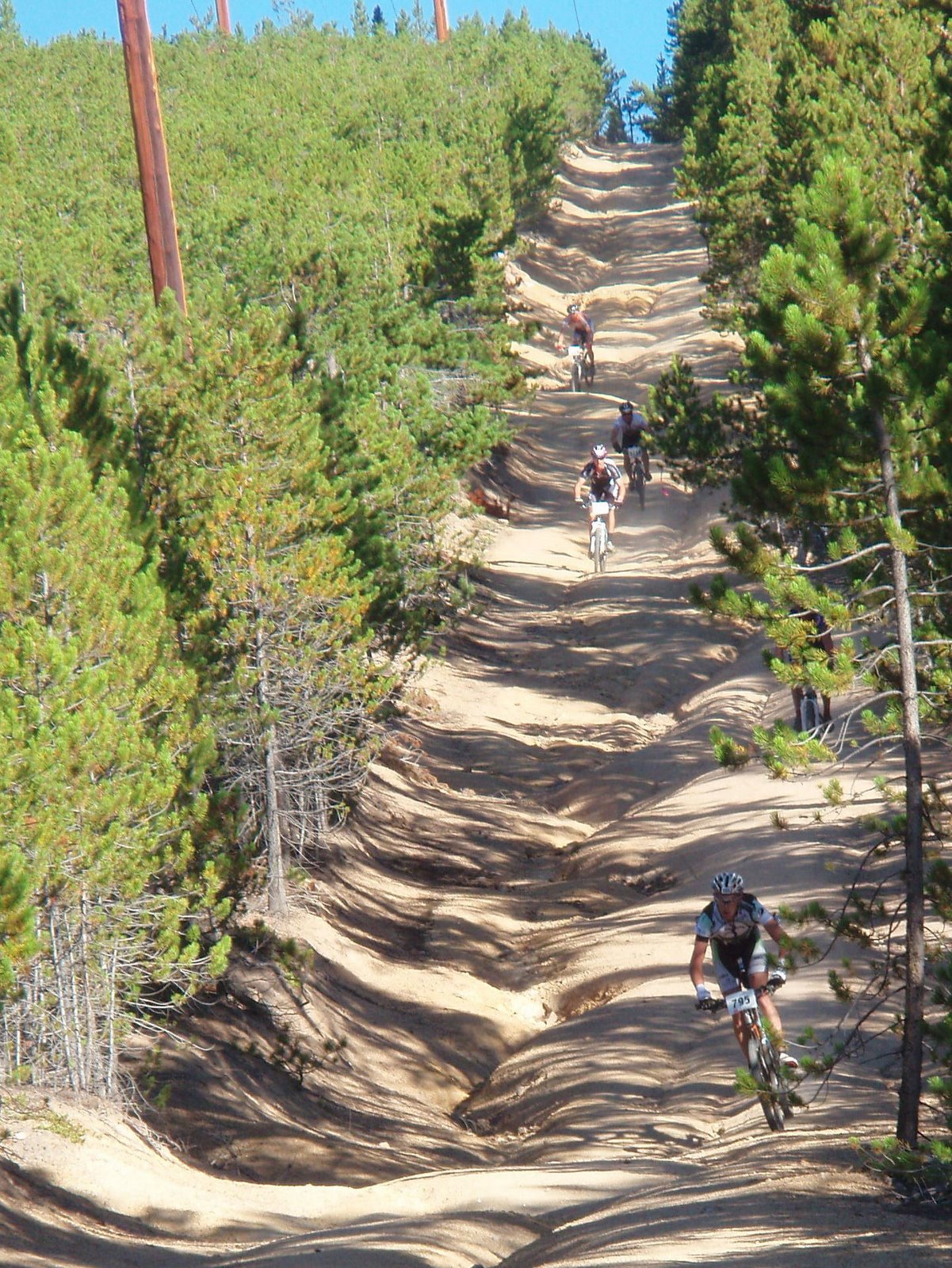
Part of Powerline. This is a shot from the bike race.
A Word on Powerline
When the chips are down and you're climbing Powerline/Sugarloaf Pass in the middle of the night with 80+ miles on your trashed legs, understand a few things. First, this is gut-check time. The Powerline/Sugarloaf Pass climb starts at about 78 miles and summits at ~82 miles, has many false summits and is an ass-kicker. It takes a lot of runners 90 minutes to get to the top. Second, look on the bright side; after Powerline/Sugarloaf, the big ascents are behind you! Third, if you believe in yourself, almost anything is possible. The Powerline/Sugarloaf climb is all about believing in yourself and not giving up. I made it over Powerline/Sugarloaf on experience alone. Do take a second to turn around and check out the many runners behind you, who are visible because of their headlamps. It's kind of a surreal scene.
Oh, and whatever you do, for God's sake don't miss the Powerline turnoff from the road out of Fish Hatchery like I (and a few others) did. We went a mile past the turn, adding two miles onto my race--an easy thing to do when you're tired and have been going hard all day. When you leave the Fish Hatchery, understand that the turn into Powerline is about a mile up the road on your left-hand side.
Hope Pass
The Hope Pass double crossing is, just on the numbers, the hardest section of the race. Over a distance of 20 miles, you're doing a double crossing of a 12,600-foot mountain pass that is above treeline, with over 12,000 feet of total elevation change. From Twin Lakes to the summit, you're looking at 3,400 feet of vertical climb. From the summit down to Winfield, you're losing about 2,600 feet. Now do it the other way. Add it all up and you get 12,000 feet. It takes anywhere from 5-8 hours for many runners to do this section. It's no surprise Winfield is a popular DNF spot.
Unless You Want to Camp in Your Car...
Get your race weekend lodging ASAP. Lodging in Leadville during the races goes fast. Reserve yours now.
Even in August It Snows...and Watch for Lightening Too
Bring plenty of gear, including gear for rain, snow and sleet. Colorado weather can change in an instant and afternoon thunderstorms are common in late summer.
Shoes
When you get down to it, Leadville is a very runnable course. Eighty percent of Leadville, and really all of it, can be run with road shoes. For the other 20 percent, which is the Hope Pass section, LIGHTWEIGHT trail shoes would be ideal but are not required.
Keep it Light
Keep everything as lightweight as possible. At Leadville, muling is allowed. I never took advantage of this rule, to my own detriment. Let your pacer carry your Camelbak and other gear...because later in the race, like going up the Powerline/Sugarloaf Pass climb, carrying yourself is going to be hard enough.
Last But Not Least...Have Fun and Enjoy the Views!
The Leadville 100 is situated in an incredibly beautiful and awe-inspiring section of the Rocky Mountains. The views are spectacular and you're running through some gorgeous high country while being supported. It doesn't get much better than that. The views I most relish:
The view of Turquoise Lake from Hagerman Pass Road on the out. It's a view I'll take with me to my grave.
The views from both sides of Hope Pass, especially the backside (the side closest to Winfield). It doesn't get any better than that.
The views of Mount Massive and Mount Elbert from the road section between Fish Hatchery and Pipeline. A lot of people hate this section but I actually like it since, at heart, I'm kind of a Road Warrior. You're looking at the two highest peaks in Colorado.
Runners behind me coming up Powerline at night. Surreal. Hopefully this year (2011) when I'm climbing Powerline it'll still be light out :)
And, of course, the finish line, where you're treated to a hero's welcome!
I used to take 100-milers super-seriously. And while I still take them seriously, I've come to realize that it's all supposed to be fun. Not everyone can or would do this, so enjoy the day, take some time (but not too much time) to show gratitude to your crew and pacers, and breathe in that crisp, refreshing (and thin) Colorado high country air!
Let me know if you have any questions! But know that there are many out there who have far more LT100 experience than I do. Consider joining the LT100 Yahoo! message board.
For a few weeks now I've been wanting to write a post on how to beat plantar fasciitis but, honestly, I didn't want to jinx myself. Well, at the risk of a jinx, here goes.
I'm no doctor, but my understanding of plantar fasciitis is that it's basically a torn ligament in your foot. Specifically, it's a tear to the fascia under your foot. It starts with a dull pain in your heal, especially when you wake up in the morning. Oftentimes the pain gets better as the day wears on. But if you're a runner who ignores the signs and keeps pounding out the miles without attention to your injury, you are setting youself up for a nasty, long-term battle. I know runners who've battled PF for years.
Let me say it again. Plantar fasciitis is a torn ligament in your foot! When you look at PF in that light, it seems kind of ill-advised to think one can run through it. It takes rest and therapy.
Here are some tips for dealing with plantar fasciitis, based on my own experience with PF.
Rest
At the first sign of suspected plantar fasciitis pain, reduce your mileage and, ideally, take at least 2 weeks off from running. Cross-train instead. Most of the time, you cannot run through PF. If you try to run through it without proper management, you are in effect playing with fire. If you refuse to shut down, at least avoid hills, reduce your mileage, avoid fast stuff for a little while, ice your foot daily, massage the heel and arch, and investigate over-the-counter inserts that support your arch and heel. Do NOT overstretch the injured foot! Would you ever stretch a torn ligament?
Seek Medical Evaluation and Treatment
If the pain doesn't go away after 2 weeks of rest, see a doctor--preferably a sports medicine or foot specialist. He or she will examine your foot; do X-rays to rule out a stress fracture, heel spur, etc.; and, if indeed you do have PF, prescribe treatment--usually a night splint, perhaps an orthotic, maybe physical therapy, possibly a cortisone shot, or all of the above. Prescribed rest will likely be in the mix, too. Don't fight it. Submit to your doctor's course of treatment, but do be informed, ask questions and express any concerns you may have. Above all, set expectations. I told my doctor up front: "Dr. Ng, I run 4,000 miles a year and have big plans in 2011. I want to be able to run again. What can we do to get there?" He heard me, understood where I was coming from, and helped me get back to running. (Click on the link above or here for Dr. Ng's info. He is an excellent doctor and I also send huge props to Rob Marchant at Physiotherapy Associates. He's an Ironman triathlete and very supportive and expert.)
If Your Doctor Gives You a Cortisone Shot....
A cortisone shot is your golden opportunity to get better. But it's where I made a critical mistake that set me back several months. If your doctor gives you a cortisone shot, REST FOR 3-4 WEEKS! Do not resume your training just because your foot feels fantastic from the cortisone. The cortisone quickly reduces the swelling and boosts healing. Allow it to work and rest while it works. I didn't and I paid for it. After the cortisone wore off and my foot was painful again, I was back to square one. You cannot get multiple cortisone shots in your heel or else you risk fat pad atrophy, a rupture to your fascia, and other complications. It is a one-shot deal, but a very effective treatment--so allow it to work and don't be stupid like I was.
Get a Night Splint
When you get out of bed in the morning and feel that terrible pain in your foot, you are in effect re-injuring the fascia. You must prevent re-injury. And the best way to do this is to get a night splint. A splint will keep your foot stretched out while you sleep, allowing the fascia to properly heal. As a result of a night splint, you will notice that your foot hurts less in the morning--a good thing because it means you're not re-injuring the fascia every time you get out of bed. I tried the Strassburg Sock and hated it. It was incredibly uncomfortable and clumsy, but maybe it'll work for you. What has really worked for me is a more sturdy, robust night splint given to me by my foot specialist. I had to pay for it out of pocket ($85) since my insurance provider wouldn't cover it. Whatever you do for a night splint, be sure to massage and gently stretch your foot before you get out of bed.
Go to PT and be Patient
If your doctor prescribes physical therapy, do it. Unfortunately, I have a $1,000 deductible for PT, and so the 6 or 7 appointments I had were basically out of pocket. But it was well worth it. Through PT, I was able to access dexamethasone treatments, ultrasound therapy, electrical stimulation, deep-tissue massage, stretches, strengthening exercises and good old-fashioned moral support that made a huge difference. You have to be patient with PT. As my therapist told me, many folks with PF conclude their course of physical therapy still hurting, but in a few weeks or months they are much better. PF takes a lot of time to heal and physical therapy isn't an overnight remedy.
If You have a Serious Case, Get Custom Orthotics
I resisted custom orthotics for a long time because I have pretty anatomically sound feet and am a mid-foot striker--all good things. My PF wasn't from a structural flaw or poor gait; it was from an acute injury to the fascia or perhaps overuse. Everyone who examined my feet told me how sound they were. And so, with that thinking, I resisted orthotics because I didn't like the thought of a device "realigning" my feet. But I ultimately got the orthotics, shelling out a few hundred bucks, and I wear them at all times EXCEPT for on my runs. I know that sounds crazy. I've found that my Sole-brand inserts work well for runs and the custom orthotics are perfect for my work and casual shoes. I refuse to allow my orthotics to be a permanent solution; they are temporary and my goal is to be out of them in a year or less. That said, if you're prescribed custom orthotics, do what works for you. You may need them 100% of the time. I do think first checking out Sole-brand inserts is worth it, though. (Update: I now wear my custom orthotics on all runs and they're great!)
Do NOT Go Barefoot
Going barefoot or just in socks around the house, especially if you have hardwood floors or tile, is incredibly damaging to a foot with PF. Wear supportive sandals or shoes, but do not go barefoot...ever...until your foot is 100% healed.
Practice Self Treatment
Stick with your physical therapy regiment and also do some self treatments at home. I have found that massaging my heel and arch makes a big difference in keeping the foot loose and breaking up inflamed tissue. I have also found that the downward dog yoga stretch is wonderful for keeping the calves loose and my foot stretched. I would not recommend the downward dog stretch until you start seeing big improvement with your PF. Do NOT over-stretch the foot when you're still in the early stages of pain.
If You're Willing to Go the Medical Route, Be Ready to Shell Out a Lot of Money
I had to spend a lot of money to get better. Between my physical therapy, orthotics and night splint, the costs added up. I'd do it all over again. If you asked me, "Wyatt, I can only afford one treatment. What should I do?" I'd recommend a cortisone shot and 4 weeks of rest--as in no running at all. If you can't see a doctor, then I'd recommend a night splint and rest. Cycling, elliptical, etc. will have to do and, really, some time off will do your body some good.
The Biggest Lesson I Learned
I waited too long to get treatment. My PF manifested in July when I was at the height of my Leadville 100 training, knocking off 100-110 miles per week. I trained through it and even finished Leadville, but in the process I developed a chronic injury that would take 7 months to begin to heal. The key to beating PF is managing the injury at first sign. Rest. See a doctor if rest doesn't work. Wear a night splint. But do not try to run through it. You have a torn ligament. Face that fact and put your ambitious race plans on hold for a while. If you don't, you could literally end your "career" as a runner. There were days when I thought the party was over.
I know plantar fasciitis is a hot topic with many runners, and a difficult injury to manage. So please let me know if you have any questions.
Although I'm not a Dean Karnazes fan by any stretch, last night I read a few excerpts from his forthcoming book, Run!, in the latest issue of Runner's World.
First of all, let me share some thoughts on Dean. I admire his ability to run great distances. I respect his many top-10 finishes at the Western States 100 and his wins at both the Badwater Ultramarathon and Vermont 100. I admire his charitable pursuits and passion for helping kids through his foundation. And, I really admire how he's successfully marketed himself and built a brand. That last compliment may sound like a back-handed compliment, but it's not. I truly admire Dean's effectiveness in promoting himself in such a way that running now pays the bills. Few of us who work for a living and run on the side (our true passion) wouldn't give anything to have Dean's "job" and, oh by the way, his North Face sponsorship. For years, I've been nagging myself to write a book because Dean has clearly shown that you can make a living through running and telling great stories. Here in Colorado, the stage is set for me to tell captivating stories. I just need to get off my arse and give it a go! So there's a lot about Dean that I do admire.
Now for what I don't admire about Dean. I don't admire the fact that he never paid homage to the sport of ultrarunning in his first book, Ultramarathon Man: Confessions of An All Night Runner. The net result of this is that you now have legions of Dean fans who think he's the first and only guy to run super-long distances. No where in his book does Dean talk about the great ones, like Yiannis Kouros or Ted Corbitt, or the roots of going long. He kind of made it seem as though he IS ultrarunning. In truth, he's the first ultrarunner to have ever really crossed over into the mainstream. But he's not the first ultrarunner, and he surely isn't the last, and he certainly isn't an all-time great in terms of results. He's not in the same league or even close to the same league as Kouros, Corbitt, Scott Jurek, Eric Clifton, Stu Mittleman, Bernd Heinrich, Ann Trason et al.
There are some great ultrarunners out there who could have huge brands except for the fact that they either choose not to effectively market themselves or they don't know how. Meanwhile, Dean is the best-known ultrarunner in the world--and this irks the hell out of many an old-school ultrarunner.
I also don't think Dean is particularly humble, though he loves to come across as Mr. Everyman. Dean seems to enjoy telling people his body fat percentage. And he can be a little condescending.
As for his new book, Dean does get one thing right. According to the excerpt in Runner's World, he says that a 100-miler isn't twice as hard as a 50-miler; it's more like 3 or 4 times harder. I agree. In my view, there are four distinct stages of a 100-miler.
Miles 1-30: Getting warmed up and finding your groove. This isn't so bad!
Miles 31-60: Damn, this is getting hard. And you still have a ton of miles in front of you.
Miles 61-90: Lots of DNFs in this stage. For me, this is when the race really begins.
Miles 91-100: You'd think this late in the race a finish is in the bag. But really it's gut-check time. How badly do you want it?
I have a friend who says that nothing good happens after 50 miles. True in many respects.
What happens after 60 miles is hard to put into words. For most of us, you have to dig deeper than you ever have in your whole life. You are stripped down to nothing more than your soul. Everyone on the course is hurting when they reach this point in the race. Look into the eyes of a 100-mile runner late in a race and you'll see what I'm talking about. Those who finish are the ones who either avoided serious injury or found it deep within themselves to put one foot in front of the other and keep going. It's really a matter of refusing to quit.
I've been in different situations after 60 miles. At the Mohican 100 in 2009, late in the race I was killing the hills and eventually took and kept the lead with nothing but fire in my eyes. The previous year, I endured a blown-up knee and massive diarrhea. At the Leadville 100 after mile 80, I was on a death march. In 2008, I paced a friend who was winning his 100 but had a medical condition after 80 miles. He recovered and regrouped and still managed to finish first overall. I've see 100s from different viewpoints--blown up-knees, altitude sickness, a wicked case of the trots, an electrolyte imbalance, a near-nirvana state, you name it.
Especially around this time of year, I often get asked for advice from people who want to start running and need some direction. Few things excite me more than sharing my love of running and trying to bring as many folks "under the tent" as possible. The running community is very tight-knit and supportive. I could go to any race in America and instantly find a common bond with those around me. In a special kind of way, all runners are friends. We look out for each other.
Unfortunately, so many people view running as a form of punishment. When I played high school football, punishment was 100-yard intervals and hill repeats. But to me, running was never punishment--I loved it! In reality, running is as natural as walking, and it's always a great thing when someone feels the urge to start running. I say go for it!
In my last post, I shared some insights on what worked for me in losing and keeping off more than 50 pounds. Here, I'd like to share 10 tips for the aspiring runner. But before I share my 10 tips, I do urge anyone seeking to take up a new exercise regiment to first see their doctor.
Now for the 10 tips!
1) Because it's so very important to have a pair of running shoes that fit your feet and provide the support and/or cushioning you need, buy a new pair of treads from a specialty running store. It's always ideal to start off in new shoes. There are basically three types of running shoes:
Stability: Provides an extra level of stability for your feet.
Neutral cushion: Usually for the runner who has a neutral foot and needs less support.
Motion control: For the runner who severely over-pronates (foot goes inward)
At a specialty running store, you'll benefit from a sales person--likely a runner--who understands your feet and will recommend the type of shoe appropriate for you. You will not find this level of service or expertise at the big-box retailers. If cost is an issue, first find out what kind of shoe you need and then look for similar close-outs at National Running Center, Road Runner Sports, etc. FYI, running shoes will last about 400 miles. Keep track of your mileage so you know when to replace them. And, of course, always replace your shoes if you start experiencing foot, ankle, knee, hip or back pain.
A quick word on the burgeoning barefoot running movement. Barefoot running and Vibram Fivefingers have their place in some programs and for some runners. But forget about minimalism for now and get some shoes that work for you and go for it.
2) Just as important as running shoes, get some socks specifically made for running. Avoid socks that are cotton and instead shoot for socks made from Coolmax fabric. I've tried virtually every brand of running sock--including the obscure and the "next big thing" brands--and I always come back to Thorlo. Thorlos are a bit pricey--about $13 a pop--but so worth it and I rarely get blisters. If that's beyond your budget, no worries--there are less expensive brands out there.
3) Have a positive attitude and be patient. Running can be challenging, but as you get in better shape you'll find that it feels more natural and is less and less of a struggle. Start gradually. If running is all new to you, start off with a 5-minute walk, 1-minute run/jog routine and add onto your running time as your conditioning improves. Be systematic about it. Eventually, the goal is to run most of or the whole time! Eventually, you may even venture to the track for some speedwork!
4) Sprinkle in some cross-training. Cycling, swimming and the elliptical are great non-impact cross-training options. When I'm really in a zone and clicking off 100+ miles a week training for a big race, I often forget to cross-train or don't make time for it. Big mistake. Cross-training works different muscles, helps correct imbalances and basically gives your legs a break from the impact. Make time for it.
5) For now, don't try to hammer the hills. Eventually, you'll be running and maybe even crushing it up the hills. More immediately, focus on running the flats and power-walking the hills...unless you really want to run the hills.
6) Try to run on the softest-possible surfaces, which are gentler on your joints. This is especially important for those who are overweight. If you don't have access to dirt trails, run on asphalt if it's safe to do from a traffic standpoint. Or, if you can find a road with a dirt shoulder, go for it.
7) If resources allow, buy some Coolmax clothing. Coolmax is a type of fabric that wicks away moisture and breathes nicely. Cotton doesn't breathe and it doesn't wick, and it causes chafing. Coolmax apparel for running is easy to find and readily available at your specialty running store and even at the big-box stores. Apparel names I like are The North Face, Salomon, Pearl Izumi, Brooks, Adidas, UnderArmour, New Balance, Saucony and Asics. There are some less-expensive brands such as Champion (available at Target) and Starter (available at WalMart) that will probably suffice. A word of advice--I have some Coolmax apparel that I've been wearing for 6+ years. Coolmax is very durable and worth it.
8) Stretch before and after running! Although some discount the importance of stretching, I think it's really important if you're a runner. Tight muscles can place a lot of stress on your ligaments and tendons. The key is to stay limber without over-stretching.
9) Work on your core. For the runner, strong legs are king, but so is a well-developed core that includes the abs, hips, glutes and back. In time, you will also find that arm endurance is important. There are lots of plank exercises that are great for core and overall strengthening.
10) If a marathon is your ultimate goal, set manageable sub-goals that prepare you for 26.2 miles. For now, focus on a strong effort at a local 5K or maybe even 10K. You need to gradually work up to your goal. Rome wasn't built overnight! I highly recommend that you look into local running clubs, where you'll benefit from knowledge, experience and camaraderie. Also consider some excellent training plans from the likes of Hal Higdon, Jeff Galloway and others. I am not a certified coach, and so I don't have the training to provide a detailed plan.
Bonus: If you're on a tight budget, no worries. Let's imagine for a second that I have $150 to spend in getting me suited up for running. Here's how I'd spend it:
$90 for shoes at my specialty running store
$30 for 3-4 pairs of running socks
Remaining funds for Coolmax shorts and a Coolmax shirt at Target, WalMart, Kohl's, etc.
That doesn't leave anything for winter apparel. For now, sweat pants, a sweat shirt, a standard toboggan, mittens, etc. will be OK. Chip away at your running wardrobe and gear with every paycheck you get. Over time you'll be able to build up your arsenal and even get some fancy, useful gadgets like a running watch or GPS. For now, running shoes and running socks are the key. They are always the key!
One final thought: If you're going to be running at dark, please get a headlamp, reflective gear, and ideally a blinking red light. Also carry identification and even a mobile phone (I do not have a PDA because it's too large and bulky for running; instead, I have a small mobile phone that I run with). Consider a RoadID bracelet (available for $20). You can buy the lights and reflective gear at a specialty running or bike store or even the local big-box sports store.
Below is a video that I think is pretty useful. Form is very important. This will be helpful.
Good luck and let me know if you have any questions!
Happy new year! It's 2011 and many people (including yours truly) are setting goals for the new year. For me, the big goal for 2011, of course, is to get healthy. I've had a severe bout of plantar fasciitis since July and am only now seeing significant progress in my foot thanks to time off from running, physical therapy, a night splint, and self therapy. An orthotic designed for runners is on the way and I'm feeling optimistic about my foot for the first time in months. If my progress continues and I'm able to be at 100%--or damn close to it--by April, here are some goals for the year:
Break 2:55 in the marathon. My current PR is 2:58 and since then I've run two 2:59s. I was planning to go for a sub-2:55 at the 2010 Vegas Marathon, but my foot injury dashed those hopes. A spring 2011 marathon PR effort is an outside possibility, but realistically I think my PR push will have to be in December 2011 at either the Vegas or Sacramento marathons.
Top 20 at the Leadville 100. Entering the Mayqueen aid station (mile 86.5) at the 2010 LT100, I was in the top 25, but altitude sickness landed me in a cot at Mayqueen for 40+ minutes as more than 50 runners passed through. I still got the big buckle and a sub-25-hour finish, but I wasn't and am still not satisfied AT ALL with the result. In 2011, my big goal is to finish top 20 at Leadville.
Break 4:30 at the Leadville Trail Marathon. This is an ambitious goal as the LT Marathon is one tough race. At the 2010 LT Marathon, I finished with a 4:55, which is a very solid time, but again I wasn't and am still not satisfied with my time. Is a theme emerging?
Summit all of the Front Range 14'ers. The Front Range 14'ers are Evans, Bierstadt, Greys, Torreys, Long's and, of course, Pikes Peak, which I've already done twice.
Stay healthy for the whole year. In the last three years, I've suffered injuries that really complicated things. In 2008, it was a patella femoral injury during the Mohican 100 (still finished 4th overall) that required PT and basically cost me 5 weeks of quality running (I still managed a 2:59 at the 2008 Columbus Marathon a few months later). In 2009, after a 131-mile effort at the USA 24-Hour National Championship in Cleveland, I suffered inflammation of the bursa sac behind my left Achilles heel, along with a sore arch and knee. It took me a full two months, including PT, to come back from that injury. And of course this year the story has been plantar fasciitis. With some recovery and cross-training built in in 2011, my plan is to stay healthy the whole year!
***
If your goal in 2011 is to lose weight and get healthy, I'm wishing you success! You can do it! What's stopping you?
I know what it's like to fight with weight and the aches and pains of carrying too many pounds. In 2003, Anne and I made some diet changes in our life together and we've never looked back. We started eating healthier and my weight plummeted. I went from a pudgy 219 pounds to 168 pounds--from a dude many perceived as a "big guy" to a dude many people see as "slim." I went from size 38 pants to size 33, from a size 46 suite to a size 42, from an XL to a large and sometimes medium, from a fat face to a bony face. But best of all, my lower-back pain went away, my confidence improved and success ultimately came my way.
Excess weight is devastating to one's health. Complications and problems from being over-weight or, even worse, obese include back and spine pain, joint problems, diabetes, heart disease, cancer (cancer cells feed off sugar), stroke and low self-esteem (which can contribute to depression). Simply put, the #1 killer in America today isn't heart disease or cancer; it's obesity!
For me, the weight-loss didn't happen overnight. Even when I was over-weight, I was still ripping off runs of 4-5 miles but eating the wrong foods (like KFC, mashed potatoes, too much red meat, cookies, etc.) and smoking a few cigarettes a day. Not until we changed our diet did the weight finally start coming off, allowing me to amp up my running and eventually focus on a dream I had since I was 17 or 18--finishing a marathon. This experience tells me that changing your diet is the single-most important thing you can do to bring weight-loss. Here are seven tips:
Eat whole grains. This includes whole-wheat pasta, whole-grain bread, brown rice, whole-grain cereals (preferably oat meal, but not the instant kind) and sweet potatoes. The grainy texture of these products may seem strange at first, but give them a shot and stick with it for a while. I'm now a big fan of flour-less bread, such as Ezekiel, that instead has whole grains. Whole-wheat and whole-grain products help prevent your blood sugar from skyrocketing like it would as a result of simple sugars. It takes a lot longer for the sugars in whole-grain products to be broken down, and so the release into the bloodstream is slower. Skyrocketing blood sugar, as is the case with simple sugars such white rice, white potatoes and really bad stuff like pop, is very bad for your weight and health. An added benefit of whole-grain foods is better digestive function. I really like Hodgson Mill whole-grain products and am a huge fan of Safeway's whole-grain organic pasta line. Uncle Ben's makes great brown rice; buy the kind that takes 30 minutes to cook. With oat meal, avoid the instant kind since it's loaded with sugar and instead buy the kind you cook on the stove top. Quaker's 1-minute oats are great!
Consume lean proteins and avoid red meat and pork. Lean proteins include everything from nuts, poultry and fish to skim milk and yogurt.
If possible and if resources allow, consume organic products and avoid meat and poultry from animals that were fed corn products. Cows are not supposed to eat corn, and yet that's a big part of their diet these days since corn-feed is so abundant and cheap. Cows were intended to graze in fields. Avoid red meat from cows that were fed corn (which is 99% of the meat at your local supermarket) as these cows just aren't as healthy, lean and happy as grass-fed cows. The same goes for poultry and, believe it or not, farm-raised fish. I'm a huge fan of free-range chicken, grass-fed beef (in strict moderation, as in once a month), wild-caught fish and cage-free eggs. You will probably need to buy these products at a higher-end grocer like Whole Foods, Fresh Market or, here in Denver, Sprout's (or, better yet, the farmer's market)...but it's worth it. The added cost of meats may ultimately cause you to eat less of them--a good thing--and cook more vegetarian meals (another good thing).
Focus on fruits and veges. I love salads with olive oil and balsamic vinegar. I pretty much have given up all store-bought salad dressings since they're loaded with garbage. My favorite veges are broccoli, spinach and and red peppers. My favorite fruits would have to be fresh pineapple (wonderful anti-inflammatory qualities), apples, honey dew and bananas. I eat an apple a day.
Drink lots of water and stay hydrated. You can curtail your appetite significantly by just drinking lots of water.
At all costs, avoid refined sugars, fast food, processed "foods" and anything with high-fructose corn syrup. Popular refined sugars include white rice, white pasta, white bread (basically any bread that's not 100% whole wheat or 100% whole grain), white potatoes, soda pop, candy, and desserts. High-fructose corn syrup (HFCS) is, in my opinion, the #1 worst thing you can eat with the possible exception of trans fat-laced foods (which usually also have HFCS). Science is now starting to show the critical danger of HFCS. A chemicalized product that is cheap, HFCS is super-sweet, makes you feel nasty and has secretly replaced good, old-fashioned sugar in literally thousands of products on the grovery store shelf. It makes us fat! HFCS is used in everything from mainstream mayonnaise, sauces, ketchup and dressings to cereals, cookies and pop. You can buy all of those things and more without HFCS--you're just going to have to pay more. If you rid yourself of products with HFCS, you will be amazed how much better you'll feel.
If you do nothing else, never, ever drink calories, especially soda pop which is laced with high-fructose corn syrup. Avoid sugary coffee drinks like mochas and lattes, pops (which are laced with HFCS), "fruit" juices, and sweet tea. If you love sweet tea, use Spenda instead of sugar. Try diet juices and diet pop, although pop in all forms should be avoided. I admit that I am a big fan of Crystal Lite, which contains the ever-controversial phenylalanine. At the end of the day, water reigns supreme.
Click here for more details. Exercise takes it all to the next level. Do it gradually and set realistic goals. Before I ran my first marathon (2004 Columbus, 3:22), I paid my dues, finishing a few 5Ks and a 20K and being an active member of a running club where I learned the ropes.
Then if you become a marathoner, as I did when I hit about 180 pounds in 2004, the weight really comes off. I didn't turn to marathoniong for weight-loss. I love running and it's only by good fortune that my passion is also a great way to get and stay healthy. Since 2004, I've shed about 12 more pounds and am holding steady at 168 pounds (around 165 if I'm really in good shape and primed for a big race).
Writer's note: This post has been in the works for a while and I've finally completed it! Updated: 7.20.2011
So, you're drawn to Leadville and that big silver and gold belt buckle? Let me tell you about my own experience with "The Race Across the Sky" and share a few observations. Maybe that'll help you decide whether or not to take on the big, bad Colorado Rocky Mountains and one of the nation and world's most famous 100-mile foot races.
My El Plato Grande buckle. Note the quarter, which gives you a good idea of how big the buckle is.
***
Leadville. It captures the imagination. It captured mine. It still does. In times like these, people are looking for fulfillment and meaning. They feel pulled to a place like Leadville. Only Leadville is more than a place. It's a state of mind. It's an experience. It changes you. Forever.
Not that long ago, the very idea of completing the Leadville Trail 100-Mile Run was but a crazy dream because at the time I lived at sea level--Cleveland, Ohio to be exact. Cleveland has some challenging hills and some amazing trails (along with a wonderfully vibrant running community that makes Northeast Ohio a hotbed of ultrarunning), but what it doesn't have are huge, rocky mountains and thin air. The city of Leadville, as many know, is situated at 10,200 feet deep in the Colorado Rockies and is the highest incorporated city in North America. The 100-mile foot race is run entirely between elevations of 9,200 feet and 12,600 feet. That's more than 2 miles in the sky, hence its well-known "Race Across the Sky" nickname. Incidentally, the Leadville Trail Marathon tops out at nearly 13,200 feet and is, quite simply, a vicious slap across one's face, but nonetheless a great experiece in and of itself as it's run on old mining roads.
When we decided to move to Colorado in 2009, races like the Leadville 100 and Hard Rock 100, along with dreams of life out West and experiencing the outdoors with my wife, Anne, and our son, Noah, were big motivators. I instantly set my sights on Leadville and, in the longer term, Hard Rock, which is even more difficult. Only a few weeks after arriving in Colorado in early April of 2010, I made the plunge and registered for both the 2010 Leadville Trail Marathon and Leadville Trail 100-Mile Run. As chronicled on here, I completed both (4:55 in the Leadville Marathon and 24:47 in the Leadville 100), but not without suffering through miles and miles of thin air trekking up some nasty climbs (also click here for my 2011 Leadville Marathon report). For as long as I live, I will never forget the death marches up 13,185-foot Mosquito Pass (the turnaround point for the Leadville Marathon) and up the backside of 12,600-foot Hope Pass, more than 50 miles into the 100. I'd be remiss in not also mentioning the difficulty of the Powerline/Sugarloaf Pass climb more than 80 miles into the 100.
For this lifelong flatlander turned Coloradan, these struggles weren't about a lack of leg strength or endurance (I have plenty of both); they were about oxygen debt. When you go into oxygen debt, you go into slow motion. You might eventually come down with altitude sickness.
Ultrarunning is by its very nature a noble sport. It requires extraordinary strength of character, a well-trained mind and body, and plenty of determination. It's an up-before-dawn, day-in-and-day-out, blood-sweat-and-tears, rain-sleet-and-snow endeavor. Most ultrarunners I know are very humble, salt-of-the-earth people who would give the shirt off their back to help another. I can't decide if ultrarunning brings out these qualities, or if ultrarunning attracts people with these qualifies. My guess is some of both. At any rate, Leadville is a tangible manifestation of these qualities. In order to complete (note that I'm using "complete," not "attempt") a race like Leadville, you have to be humble and have character, yes, but you also need a little mojo and, deep down, you need confidence. You have to believe in yourself and--I would argue--a higher power far greater than your own abilities. And, you have to believe in the motto of the race:
You are better than you think you are, and you can do more than you think you can.
Just about anyone who's experienced and finished Leadville knows those words aren't a platitude; they mean something. Because when the chips are down and you're climbing Powerline/Sugarloaf Pass in the middle of the night--with more than 80 grueling miles on your severely trashed legs--you have to dig deep and believe that, yes, you can do it. In the spirit of the hard rock miners, if you dig deep enough, you will find silver and gold--in the form of a finisher's belt buckle. But you'll find far more. Leadville takes you close to the edge (I would guess races like Badwater and Hard Rock take you even further to the edge) and deep into your own soul--places you've probably never been.
It is hard to describe what it was like, and how hard it was, to complete high-altitude races of 26.2 miles and 100 miles, respectively, when for the first 37 years of my life I breathed thick, voluminous sea level air. When you're running or, as often is the case, hiking at 12,000 or 13,000 feet, the very act of eating (if you even feel the urge to eat) is hard work. (LT100 record-holder Matt Carpenter reportedly dissolved PowerBars in water for his raceday fuel.) Your legs are heavy.as.lead. You can't really catch your breath. You feel deflated. Your head may be pounding or, at best, you're dizzy. You're in slow motion. And all the while you're above treeline, where the weather can change in an instant. You're shuffling along a rocky, technical trail that requires your full attention. On my first summit of Pikes Peak back in June, I quickly realized when I was post-holing through 3-foot-deep snow at more than 13,000 feet--and fighting acute exhaustion--that I wasn't in Ohio anymore. The following photo from my Pikes Peak adventure in June (I've since summitted Pikes for a second time) illustrates the point. Yes, those are clouds far below.
It took several months to really acclimate to life at more than a mile in the sky (our home is in Parker, Colorado, which is at 6,100 feet and about two hours from Leadville). I've nearly had to learn to run again; the stress high-altitude running places on your mind and body is enormous compared to that of sea level running. My Leadville 100 training landed me with a devastating foot injury for which I'm still being treated--an injury that stemmed from the ungodly strain of high-altitude training combined with blissful ignorance. I'm hopeful that in 2011, with a year of living at elevation under my belt (and hopefully a healthy foot), I'll see big improvement in both my Leadville Marathon and Leadville 100 times. I don't mind saying that I never could have finished the Leadville 100 had I not had a supportive wife, an inspirational son, an amazing crew consisting of my brother and mom, and inspiring pacers...along with the intangible experience of finishing four races of 100+ miles. Yes, I dug deep.
One of those races was a win at the Mohican Trail 100-Mile Run in 2009. Yeah, on the heels of the Mohican win, I thought I was kind of a badass. And then we moved to Colorado and I ventured to Leadville, where I was humbled and got my ass handed to me not once but twice--the marathon in July and the 100-miler seven weeks later. In the 100, 700+ runners started. Half finished. And of the finishers, only 99 of us earned the big-ass sub-25-hour buckle. About five miles out, I passed a dude who had been trying for five years to get the sub-25 buckle...and valiantly came up short every time. I worked for 24 hours and 47 minutes for that buckle, coming back from the dead at the Mayqueen aid station (mile 86.5), where I was laid up for more than 40 minutes with altitude sickness.
***
For me, the allure of Leadville isn't just the mountains; it's also the city itself. Leadville has a truly extraordinary "boom and bust" history. At one time, Leadville was among the wealthiest cities in Colorado--a bustling mining town and silver mecca two miles in the sky. It's where fortunes were made and lost. And it's certainly a town with its fair share of colorful characters. Doc Holliday and Wyatt Earp hung out there. Lots of outlaws came through town. Maybe this is why the Leadville 100 has such a cowboy feel to it (to me, the term "cowboy" conjures up good thoughts; it is indeed unfortunate that the term has now taken on negative connotations). During World War II, soldiers at nearby Camp Hale were forbidden to go into downtown Leadville, where prostitution, drinking and general carousing were a way of life.
The city boasts a beautiful opera house, built in 1879 by Horace Austin Warner Tabor, who was Leadville's first mayor and ultimately made millions in the mining business. If you're from Leadville or even if you live in Denver like we do, the names Horace Austin Warner Tabor and Baby Doe Tabor are quite familiar. At miles 7 and 93 in the Leadville 100 course, runners may access their crew at the Tabor Boat Ramp, named in honor of Horace and Baby Doe, who sadly died broke. Baby Doe froze to death in their Matchless Mine.
In "Born to Run," McDougall paints a rather animated picture of Leadville. As previously reviewed on here, McDougall is quite the storyteller and, at times, colorful, with a tendency for exaggeration. But I think he does a nice job of depicting Leadville, where in the early to mid 90s the Tarahumara Indians in Mexico's dangerous Copper Canyons fielded some incredible runners including the team that bested the indomitable Ann Trason, contributing to the Leadville 100 legend. (As depicted by McDougall, Trason was a petite "community-college science teacher" who routinely opened up a can of whoop-ass during ultra races, compiling an unparalleled running resume over the course of her historic career.) In many corners of the ultrarunning world, the Leadville 100 is nearly mythical, and I think the city and its people are a big reason why the Leadville 100 and the entire Leadville racing series are so unique.
Although Doc Holliday and Wyatt Earp are long-gone, the residents of Leadville nowadays are still pretty tough folks. Living at 10,000+ feet, with the brutal winters of the Colorado high country, is hard living. As quoted in "Born to Run," Ken Chlouber says Leadville is a home to "miners, muckers and mean mother fuckers." Living in Leadville got even harder as the 1900s progressed. The repeal of the 1928 Sherman Silver Purchase Act was a dagger near the heart of Leadville, whose economy centered a great deal around silver mining. But the town, sitting atop highly mineralized earth, had more than silver to mine. It had lead and zinc--and plenty of it. And so the Leadville economy survived the doing-away of the Sherman Act.
But then in the early 1980s, disaster struck. In 1982, the hulking Climax mine just outside Leadville started undergoing a closure. The mine, which you pass on the way into Leadville on Highway 24, was a major source of molybdenum, which is used to strengthen steel. In fact, it was the world's largest "moly" mine, supplying about 75% of the international supply of the metal. The mine is still owned, but it's largely inactive. There has been talk of it reopening, but demand for "moly" isn't quite strong enough right now, and so the mine remains closed.
The Climax mine's closure was a disaster for Leadville. According to McDougall, some eighty percent of working Leadville citizens were employed at the mine. With the closure, the city suddenly faced a grave crisis. With a huge unemployment problem following the mine closing, alcoholism, wife abuse, and other types of violence escalated to alarming levels. What Leadville endured in those very dark years was described as "civic death." It faced a future as a ghost town. Lots of folks left.
Well, a guy named Ken Chlouber, a very tough dude who was a hardrock miner, had an idea. With Leadville's future hanging in the balance, let's see if we can turn this town into a tourist attraction and endurance junkie's heaven--even if the winters are brutal and the city is at a suffocating 10,000+ feet. So Chlouber founded what McDougall calls "a monster": the Leadville Trail 100-Mile Run. Ken was inspired by Gordy Ainsleigh, founder of the Western States 100. The Leadville 100 just wrapped up its 26th year, and is now a centerpiece of a series of high-altitude mountain races that bring major talent and lots of bodies to the area. The series includes the 100-mile mountain bike race that Lance Armstrong won in 2009 and Levi Leipheimer won in 2010. But when you're talking about the Leadville Trail 100-Mile Mountain Bike Race, you have to give props to the all-time legend, Dave Wiens.
It's easy to see that the Leadville racing series provides a major economic boost to the city of Leadville. For the most part, the entire town gets behind the races. The events bring in not only the racers themselves, but also their crew and pacers, as well as plenty of spectators. These people eat in the Leadville restaurants, stay in the hotels and lodges, shop in the stores and generally consume a lot, creating a critical revenue stream for a city with a struggling economy.
Sadly, this past summer, Ken and his longtime race partner, Merilee Maupin, sold the Leadville race series to Lifetime Fitness. I ran in the last Leadville 100 "owned and operated" by Ken and Merilee. The series is now owned by a big corporation. Let's hope Lifetime Fitness keeps these races distinctively "Leadville" in nature, honoring the legacy of a great city and its hard-rock mining tradition. Anything less would be a tragedy.
***
If you're interested in trying the Leadville Trail 100-Mile Run, allow me to offer a few observations based on my own experience, what I've learned from others, and mistakes I made.
Know what you're getting yourself into. It's clear that McDougall's book is bringing a lot of people to Leadville every summer. I wanted to run the Leadville 100 prior to reading "Born to Run," but I have to say the book raised my interest to an even higher level. When I was coming down Hope Pass, I saw lots of folks struggling badly up the mountain. Most of them were close to the cut-off and probably had to drop. I saw one guy lay down on a rock totally exhausted. If you do Leadville, just know that this race is very different than a sea level event.
If at all possible, spend some time at altitude before the race, especially if you've never been to the high country. In training for the LT100, I did three runs in Leadville (including the marathon), had summitted Pikes Peak and did several training runs above 7,000 feet, hard runs--as in 6:50-7:10/mile pace--on a treadmill set at 13% incline (which are likely responsiblee for my plantar fasciitis), along with running 1,500 miles in 15 weeks...and that wasn't enough to compensate for my inexperience at high altitude. Ideally, if you can do the Leadville 100 Training Camp in June, go for it--it's a golden opportunity to experience the course, learn from LT100 vets (which I'm NOT since I'm just a one-time finisher) and meet other runners.
Piggybacking off the previous tip, have a plan for raceday nutrition. I didn't realize that what worked for me at sea level wasn't necessarily going to work at altitude. Going into the 2011 race, I'm going to experiment with liquid calories such as Perpetuem and figure out precisely what works for me. There is no one-size-fits-all approach to raceday nutrition. Figure out what works for you, but know that for many eating solids at 10,000+ feet can be brutal.
If nothing else, for pre-race on-course training do the Hope Pass double-crossing out-and-back, starting at and coming back to Twin Lakes.
Work on your hiking, especially uphill hiking. You will hike some of the front side of Hope Pass and basically all of the backside of the pass. You will also hike a big portion of the Powerline/Sugarloaf Pass climb. Training runs are seperate from training hikes, but you could incorporate both into your long outings.
I carried trekking poles over Hope Pass and up the Powerline/Sugarloaf climb. Do I recommend them for all LT100 entrants? For some runners, yes. For other runners, no. I will likely NOT carry them in the 2011 LT100 but my crew will have them on hand just in case. My concern about trekking poles at the LT100 is that going up Hope Pass you probably don't want to wear a Camelbak because it's too heavy. You probably want to carry a single water bottle and maybe have a second bottle on a belt. It's hard to handle a water bottle when you also have trekking poles.
If your goal is to finish the LT100, I would avoid doing the Leadville Trail Silver Rush 50-Mile Run, which many use as a training run, since it's 6-7 weeks before the 100 and I think that's not enough time to fully recover from 50 miles at altitude. Instead, I would do the Leadville Trail Marathon in early July as a trainer and plan to venture to Leadville plenty in the following weeks for training runs. Basically any race in Leadville is going to be a significant undertaking, so plan some recovery time if you opt for the marathon as a trainer. Disclaimer: The Leadville Marathon and Silver Rush 50-Mile Run are not run on the LT100 course!
Hope Pass will likely be snow-covered through June. The best time to train on Hope Pass is July and early August. Otherwise bring snow shoes or just post-hole.
If you want a rough idea of what it's like to run at altitudes of 12,000+ feet, get on a treadmill and breathe through a straw or two for several minutes.
Do a lot of hill training. If you live in or near the mountains, there's your training ground.
If you live at sea level and have the resources, consider buying an altitude chamber.
Bring a crew and I would suggest two pacers. The crew will be critical especially from the first Twin Lakes aid station (mile 40) through the end. I would recommend at least two pacers--one who can pace you over Hope Pass and back down to Twin Lakes, and the other from Twin Lakes to the finish. Your Hope Pass pacer could also step in later in the race for relief work.
Understand that the Powerline/Sugarloaf Pass climb, which starts at about 78 miles, has many false summits and is an ass-kicker. The good news is that after Powerline/Sugarloaf, the big ascents are behind you!
Get your lodging ASAP. Lodging in Leadville during the races goes fast. Reserve yours now.
If possible, if you're from sea level, show up at least three days and ideally five days in advance. This will give your body some time to acclimate. If three to five days isn't possible, show up the day before the race.
Bring plenty of gear, including gear for rain, snow and sleet. Colorado weather can change in an instant and afternoon thunderstorms are common in late summer.
I think 80 percent of Leadville can be run with road shoes. For the other 20 percent, which is the Hope Pass section, trail shoes are ideal.
Keep everything as lightweight as possible. At Leadville, muling is allowed. I never took advantage of this rule, to my own detriment. Let your pacer carry your Camelbak and other gear...because later in the race, like going up the Powerline/Sugarloaf Pass climb, carrying yourself is going to be hard enough.
Those are just some suggestions. I'm by no means a Leadville expert. Do lots of homework, check out as many race reports as possible and consider joining the Leadville 100 Yahoo! message board, which is a great source of information. Here's a great resouce (prepared by a friend of mine, Adam Feerst of Run Uphill Racing who is a previous top-20 LT100 finisher) you might want to check out. Here's another great resource brought to you through Run100s.com.
***
Here's a video of Timmy Parr climbing the front side of Hope Pass during the 2009 Leadville 100--a race he won. When you get right down to it, Leadville is about surviving the Hope Pass double-crossing.